Emu Report on Passive House Standards: A Definitive Comparison
In the push for better buildings, a wide array of standards promise to deliver efficiency, comfort, and sustainability. From local building codes to advanced green building certifications, project teams face a complex landscape of choices. But how do these standards truly perform when put to the test? Which ones deliver on their promises for healthier, more resilient, and energy-efficient buildings?
At Emu Passive, we believe in data-driven decisions. That’s why we conducted an in-depth study, the Emu Report on Passive Building Standards. This research moves beyond simple energy metrics to provide a comprehensive green building standards comparison. We analyzed twelve of the most common building standards in the US, evaluating them across the metrics that matter most to occupants: thermal comfort, indoor air quality, durability, and resilience.
This page breaks down the key findings of our report, offering a clear Passive House standards comparison and a detailed look at how different approaches stack up against each other and against standard building codes.
Why a Deeper Comparison of Building Standards Matters
Simply asking if a building is “green” or “energy-efficient” is not enough. To truly understand a building’s quality, we need to look at its performance holistically. A standard might reduce energy bills but fail to provide good indoor air quality or keep occupants safe during a power outage.
Our research investigated how well different standards address key challenges:
- Thermal Comfort: Does the building stay comfortable year-round without drafts or temperature swings?
- Indoor Air Quality: Are occupants breathing fresh, filtered air, free from pollutants and excess CO2?
- Durability & Resilience: Can the building withstand extreme weather and maintain safe indoor temperatures during a power grid failure (passive survivability)?
- Operational Energy Efficiency: How much energy does the building actually consume for heating and cooling?
- Resource Efficiency: Does the standard encourage smart material use or lead to waste?
By evaluating standards on these multi-faceted criteria, we can make a more informed green building vs code comparison and identify the paths that lead to genuinely superior buildings.
The Standards We Analyzed
Our study performed a compare high performance building standards analysis on twelve distinct benchmarks, covering a wide range of approaches from code-minimum to the most advanced Passive House levels.
The standards included:
- Building Codes: 2018 IECC, 2021 IECC, and the 2024 IECC draft
- State & Federal Programs: California Title 24, EnergyStar v3.2, DOE Zero Energy Ready Home (ZERH)
- Green Building Standards: Pretty Good House (PGH)
- Passive House Standards (Phius): 2015 Phius+, 2018 Phius+ Core, 2021 Phius+ Core (including Prescriptive path)
- Passive House Standards (PHI): PHI Low Energy Building, PHI Passive House
Reference Projects
To execute this comparison between Passive House, building code, and other high performance standards, we modeled 50 single-family home projects across nearly every US climate zone to ensure our results were statistically significant and applicable to real-world conditions.
- 50 real-life single family projects – each with their own design, size, lot, orientation, etc.
- New construction projects
- All-electric for heating, cooling, and domestic hot water
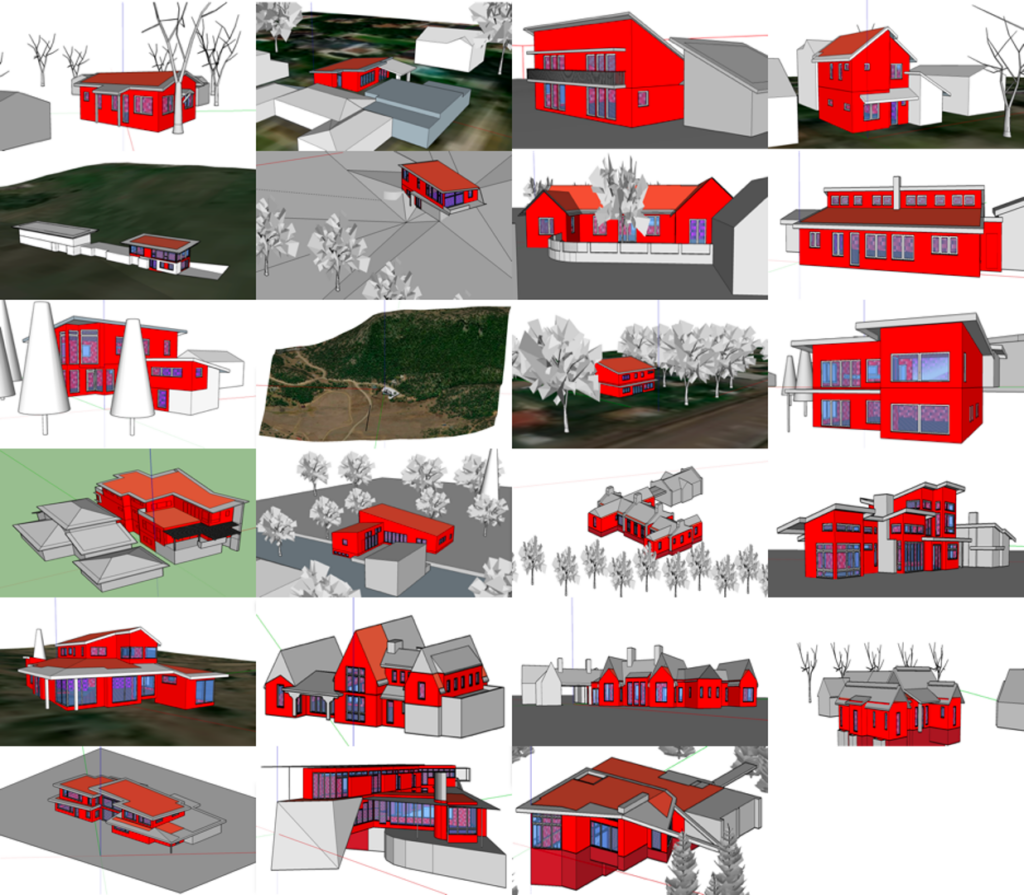
We selected the projects to have a large enough data pool to have statistical significance, to be consistent enough to eliminate outliers as much as possible, and to be distributed enough across climate zones to be representative of different conditions across the United States.

Key Metric 1: Operational Energy Efficiency
A primary goal of any high-performance standard is to reduce energy consumption. We focused on site energy used for heating and cooling, as this is where the building envelope has the most direct impact.
The Findings:
Our analysis revealed a vast difference in performance. When comparing the reduction in heating and cooling energy against a 2018 IECC baseline, the results were clear.
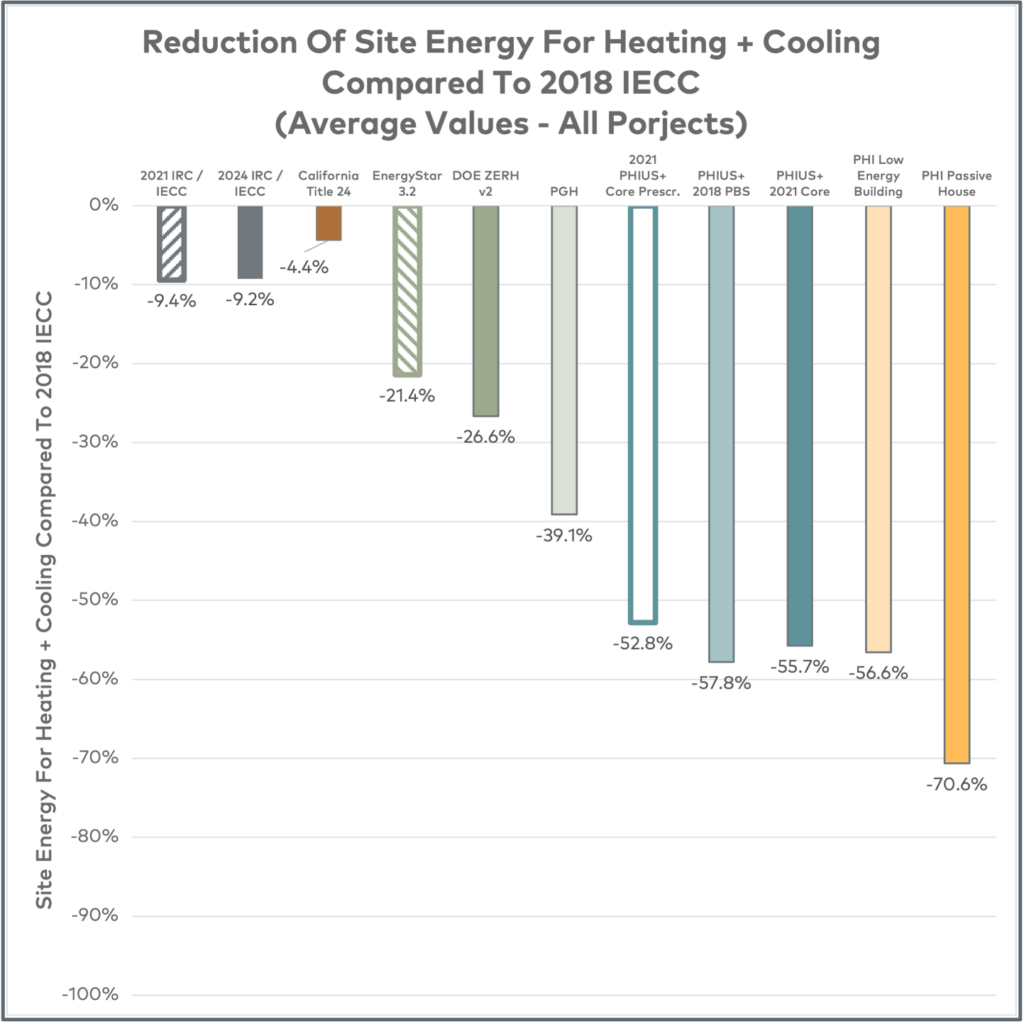
- PHI Passive House was the top performer, achieving an average site energy reduction of 70.6%.
- 2018 Phius+ Core followed with a 57.8% reduction.
- PHI Low Energy Building came in close behind at 56.6%.
- 2021 Phius+ Core achieved a 55.7% reduction.
Interestingly, the newer building codes showed minimal progress. The 2024 IECC draft offered no significant improvement over the 2021 IECC in terms of energy performance. This highlights the slow pace of change in conventional construction codes.
The energy savings delivered by Passive House standards are profound.
To put it in perspective: a home built to the PHI Passive House standard uses so little energy for heating and cooling that the remaining energy consumption is equivalent to what it would take to charge two electric vehicles annually, on top of operating a standard code-built home. This is a powerful demonstration of what is possible.
Key Metric 2: Indoor Air Quality (IAQ)
We spend around 90% of our lives indoors, making indoor air quality a critical factor for health and well-being. Good IAQ depends on several factors: continuous fresh air, effective filtration, controlled humidity, and extremely low air leakage to prevent pollutants from entering through the building shell.
The Findings:
In the compare PHI and Phius analysis for IAQ, both systems perform well, but with key distinctions.
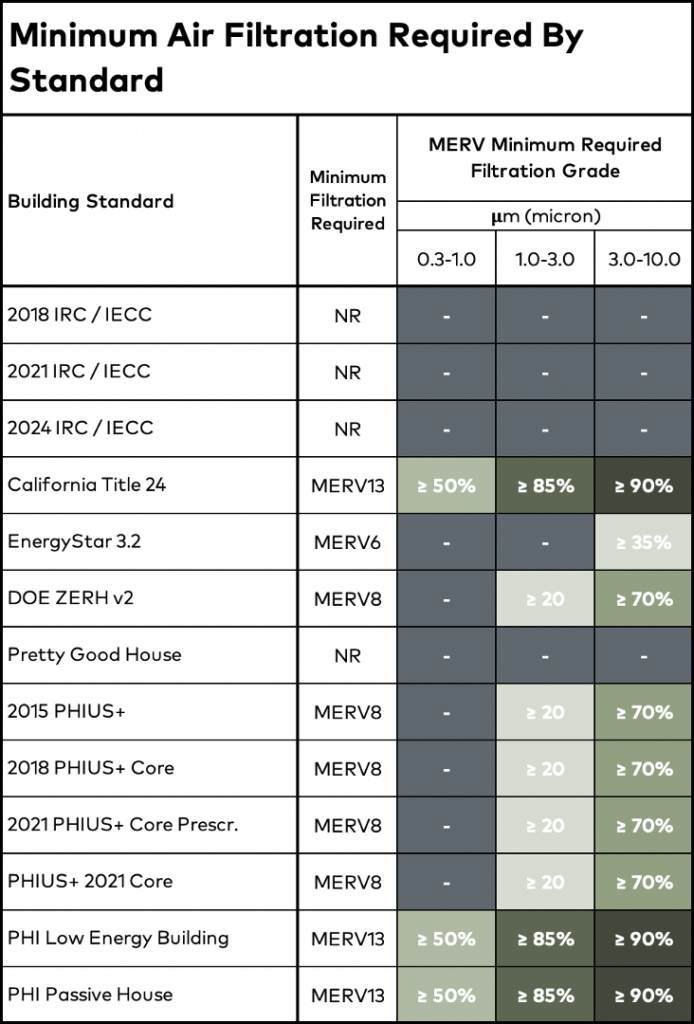
- PHI Passive House sets the most stringent requirements across the board. It demands the highest level of airtightness, requires superior fresh air filtration (MERV 13 or better), and has strict criteria to prevent mold growth on surfaces and within walls.
- Other standards, including Phius and DOE ZERH, also require balanced ventilation systems, which is a significant step up from code. However, the airflow rates and airtightness targets in the PHI standard provide the highest level of protection.
Phius only requires a MERV 8 filters, which doesn’t do much to filter particulate matter PM 2.5 – it can cause cancer. If you’re planning on following Phius for your projects, we strongly recommend upgrading your filters to a MERV 13 to really maximize the indoor air quality.
Building codes, by contrast, are far less rigorous. They allow significantly more air leakage, which can introduce dust, pollen, and moisture into the home. Their ventilation requirements are often based on less effective exhaust-only strategies, which can depressurize a home and pull in pollutants from garages, crawlspaces, and wall cavities.
Key Metric 3: Thermal Comfort
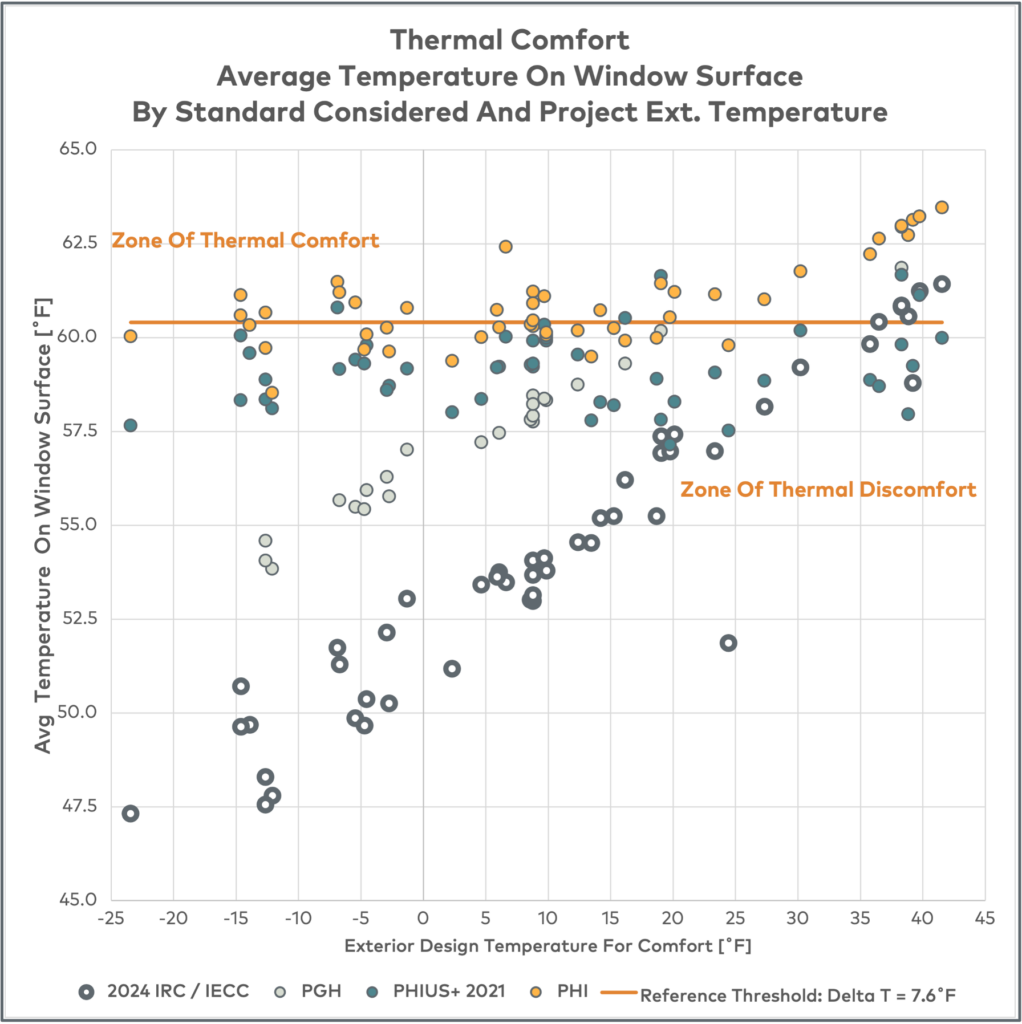
Thermal comfort is more than just the temperature on the thermostat. It’s the absence of drafts, cold spots near windows, or radiant heat from walls. It’s a feeling of consistent, stable comfort throughout the entire space. This is achieved through a combination of a highly insulated envelope, high-performance windows, and an airtight shell.
The Findings:
- PHI Passive House again leads the pack due to its strict comfort criterion. It limits the temperature difference between interior surfaces to ensure a draft-free and uniformly comfortable environment. The standard’s rigorous requirements for window performance and airtightness are specifically designed to eliminate the sources of discomfort common in conventional buildings.
- Phius also improves thermal comfort significantly compared to code, although not as much as PHI (due to the more relaxed requirements on windows and air sealing).
In a code-built building, occupants often experience drafts or feel a chill when sitting near window in winter. These issues are virtually eliminated in a Passive House, creating a truly comfortable living space.
Key Metric 4: Thermal Resilience & Passive Survivability
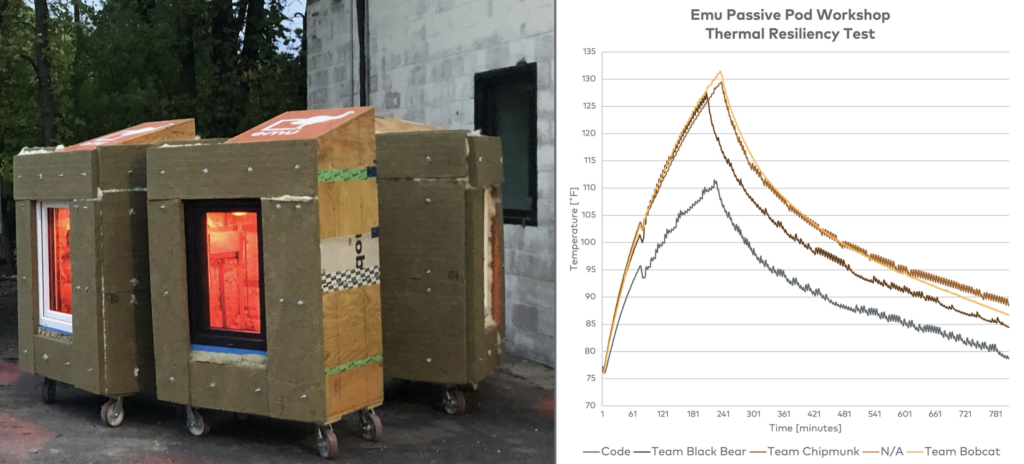
What happens when the power goes out for an extended period during a winter storm or a summer heatwave? This is the ultimate test of a building’s resilience. Passive survivability, or thermal resilience, is a building’s ability to maintain safe, livable temperatures without any active heating or cooling.
The Findings:
This is where the super-insulated, airtight envelope of a Passive House truly shines.
- Our research shows that Passive House standards (both PHI and Phius) deliver the highest level of thermal resilience. By dramatically reducing heat loss in the winter and heat gain in the summer, these buildings can “coast” through power outages for days while maintaining safe indoor conditions.
- Code-built buildings, with their higher levels of air leakage and lower insulation, lose or gain heat rapidly. They become dangerously cold or hot within hours of a power failure.
Passive House standard is not just about energy savings; it’s a critical strategy for climate adaptation and ensuring the health and safety of occupants in an uncertain future.
Compare Prescriptive vs Performance Passive House Approaches
Within the world of high-performance building, two main approaches exist: prescriptive and performance-based. Understanding the difference is key to a meaningful prescriptive and performance Passive House comparison.
Prescriptive Path:
A prescriptive path provides a simple checklist of requirements. For example, it might mandate “R-60 insulation in the roof” and “R-40 in the walls” for a specific climate zone. This approach is straightforward but often inefficient. It doesn’t account for a building’s unique shape, orientation, or window placement. You might be forced to use more insulation than necessary, wasting resources and money.
Performance Path:
A performance path sets a specific energy target for the entire building and allows the project team to decide how to meet it. Using advanced energy modeling software (like the PHPP), designers can test different combinations of insulation, windows, and airtightness levels. This enables smart trade-offs. For example, investing in better windows might allow for slightly less wall insulation while still meeting the overall performance goal.
The Findings:
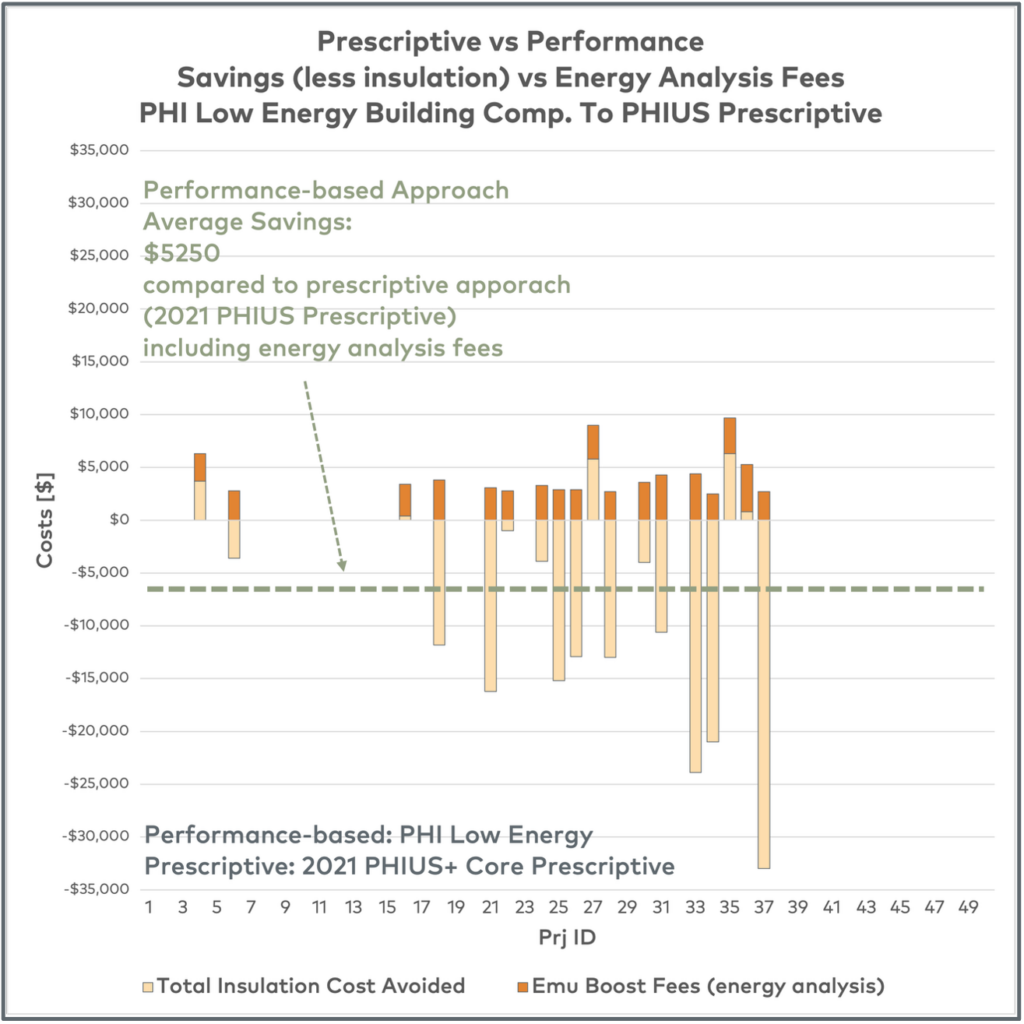
Our report confirms that the performance-based approach is significantly more resource-efficient. By optimizing the design, project teams can often meet or exceed performance targets while using fewer materials. This not only reduces the embodied carbon of the project but can also lead to substantial cost savings. The performance path rewards smart design over a blind checklist.
PHI vs Phius Comparison
A common question in the industry is about the differences between the two main Passive House standards in the US. Our report provides a data-backed PHI vs Phius comparison.
While both standards share the same core principles—airtightness, continuous insulation, high-performance windows, thermal bridge-free design, and balanced ventilation—they differ in their specific targets and climate-related methodologies.
- Energy Targets: As noted earlier, our research found that the PHI Passive House standard resulted in the lowest overall site energy for heating and cooling across the 50 projects studied. Phius performed well and very similarly to the PHI Low Energy Building standard.
- Airtightness: While both have strict requirements, PHI’s primary metric is based on the building’s surface area (q50), while Phius uses a metric based on volume (ACH50). Each has its advantages depending on the building’s size and shape. Over these 50 projects, Phius’s air tightness requirements averaged to an ACH50 target of about 1.1 (almost twice higher than PHI Passive House target of 0.6 ACH50).
Ultimately, both standards produce buildings that are vastly superior to code. The choice between them often depends on project-specific goals, climate, and team familiarity. Emu Passive’s training provides the foundational building science that empowers builders to excel on projects certified under either standard.
Key Takeaways
This detailed Passive Building Standards Comparison offers several critical insights for anyone involved in designing or constructing buildings today.
- Passive House Standards Outperform All Others: Across every key metric—energy efficiency, indoor air quality, comfort, and resilience—Passive House standards (both PHI and Phius) deliver the highest level of performance.
- Building Codes Are Not Keeping Pace: Modern building codes (IECC) are improving at a very slow rate and fail to deliver the level of performance needed to address climate change and occupant health.
- Performance-Based is Smarter: The performance path offers a more intelligent and resource-efficient way to achieve high-performance goals compared to the one-size-fits-all prescriptive approach. The savings in construction cost outweigh the energy modeling fees.
- Metrics Matter: Judging a standard solely on energy savings is shortsighted. A holistic view that includes comfort, health, and resilience provides a much truer measure of a building’s quality.
Frequently Asked Questions (FAQs)
Q: Which building standard is the best?
A: Based on our comprehensive analysis, the PHI Passive House standard ranked highest across the combined metrics of energy efficiency, comfort, air quality, and resilience. However, both PHI and Phius standards deliver exceptional buildings that are far superior to any other standard we studied.
Q: Is it more expensive to build to Passive House standards?
A: While there can be an initial uplift in cost for higher-quality components (like windows and fresh air systems) and the additional care required during construction, these costs are often offset by a simplified mechanical system and long-term energy savings. Furthermore, a performance-based approach can help optimize material use and reduce costs compared to a prescriptive one.
Q: Can I apply these principles without seeking certification?
A: Absolutely. The building science principles behind Passive House can be applied to any project to improve its performance. Understanding concepts like airtightness and thermal bridge-free design is valuable for any builder, regardless of certification goals.
Q: What is the single biggest difference between a code-built home and a Passive House?
A: While there are many differences, the most impactful is the airtight, continuously insulated building envelope combined with a balanced fresh air system. This combination is the key that unlocks improvements in energy efficiency, comfort, health, and resilience all at once.