What does comfort mean to you? For most people, a comfortable home is one where you don’t have to think about the temperature. It’s a space free from chilly drafts, cold floors, or rooms that are mysteriously warmer or cooler than others. You can sit by a large window on a freezing winter day and not feel a hint of cold. This is the essence of thermal comfort, and it’s an experience that standard construction methods consistently fail to deliver.
Even brand-new buildings that meet the latest codes often have noticeable comfort issues. You wear a sweater inside, avoid certain spots in a room, or constantly fiddle with the thermostat. Passive House changes this narrative entirely. Using advanced window building science and a holistic design approach, Passive House creates a level of thermal comfort so profound and consistent that it must be experienced to be believed. This isn’t about a more powerful furnace; it’s about a fundamentally better building envelope, with high performance window selection at its core.
Beyond the Thermostat: The Science of Feeling Comfortable
True thermal comfort is more complex than the number on your thermostat. Our bodies are sensitive to a range of factors, including air temperature, drafts, radiant heat, and humidity. Passive House addresses all of them systematically, starting with the most common source of discomfort: uncontrolled air leakage.
Eliminating Drafts with Superior Airtightness
Cold drafts are the enemy of comfort. In a typical building, tiny cracks and gaps in the walls, roof, and around windows allow cold winter air to pour in. Passive House tackles this head-on with an aggressive airtightness requirement.
The international Passive House standard requires a building to be very airtight, limiting air leakage to a maximum of 0.6 Air Changes per Hour at 50 Pascals. To put that in perspective, this is approximately 5 times more stringent than what a standard building code like the IECC demands. The Phius standard is also stricter than code, targeting an average of ACH50 of about 1.1 for a single-family homes – about 2-3 times tighter than conventional construction. This extreme level of airtightness effectively eliminates drafts from the building envelope.
For an in-depth comparison of Passive House standards and building codes, review the Emu Report on Building Standards.
Preventing Air Stratification
Airtightness also solves another common comfort problem: air stratification. This occurs when air separates into layers of different temperatures. Because cold air is denser, it sinks to the floor, while warmer air rises to the ceiling. This vertical temperature difference – cold feet and a warm head – is a classic sign of a poorly performing building and a major source of thermal discomfort. By stopping the infiltration of cold air that fuels this cycle, an airtight Passive House creates a much more stable and uniform indoor air temperature from floor to ceiling.
The Passive House Comfort Criterion: A Focus on Surface Temperatures
While airtightness is foundational, the most significant piece of the Passive House puzzle for ensuring thermal comfort is the Comfort Criterion. This is a specific, non-negotiable requirement that addresses the temperature of the interior surfaces within a building. It focuses on the thermally weakest components of the envelope – the elements with high heat loss (high U-values) and low insulation values (low R-values).
These components include:
- Windows
- Exterior doors
- Curtain walls
- Skylights
- Hatches to unconditioned spaces (like attics)
- Even pet doors and other fenestration elements
These fenestration products have naturally lower R-values than an insulated wall. A mediocre, code-minimum wall might have an R-value of R-20. In contrast, a very high performance window with triple-pane glass, two low-e coatings, and inert gas fill might only have a center-of-glass R-value of R-12. The best Passive House-suitable window manufactured in North America today has an overall whole-unit R-value of about R-8.
This lower thermal resistance means windows and doors lose heat faster, resulting in colder interior surface temperatures. These cold surfaces cause two distinct phenomena that create thermal discomfort: downdraft and radiant asymmetry.
What is a Downdraft?

When warm indoor air comes into contact with the cold interior surface of a window, it cools down. This cooler, denser air then drops towards the floor, creating a slow-moving but persistent current of cold air. This is a downdraft. It creates that chilly feeling you get when standing near a low-quality window in the winter and is a primary cause of uncomfortable air stratification.
What is Radiant Asymmetry?

Our bodies experience comfort not just from the air temperature but also from the radiant temperature of the surfaces around us. A warm wall radiates heat towards you, and your body radiates heat towards a cold surface. When one side of a room (like a large window) is significantly colder than the other surfaces, it pulls heat from your body. This imbalance is called radiant asymmetry, and it makes you feel a distinct chill even if the thermostat is set to a comfortable temperature.
Passive House directly solves downdraft and radiant asymmetry by enforcing the Comfort Criterion. This sets strict, climate-specific limits on the maximum allowable heat loss (U-value) for all fenestration products. In the design phase, the energy model tells the Passive House consultant the minimum window performance required to keep interior surfaces warm enough to prevent discomfort, based on the local climate data. This ensures a Passive House window is not just an opening, but an integral part of the comfort system.
The Right Window for the Right Climate
A common misconception is that all Passive House projects require expensive, European-style triple-pane windows. This isn’t true. The standard is performance-based, meaning you only need a window that meets the Comfort Criterion for your specific climate.
- Cold Climates: Projects in US climate zones 4 and higher will almost certainly need triple-pane glass to keep interior surfaces warm enough to prevent downdrafts and radiant asymmetry.
- Warm Climates: Conversely, projects in warmer southern climates (like US climate zone 2) can often meet the Comfort Criterion and achieve full Passive House certification using high-quality, thermally broken double-pane fenestration. This makes Passive House cost-effective and practical everywhere.
We saw this firsthand when Emu provided consulting on a multifamily project in Georgia (climate zone 2A). The developer assumed they would be the first in the state to use triple-pane windows for their Passive House project. We were happy to tell them, “No, you won’t be. You don’t need triple-pane windows to meet Passive House certification in this climate”. They were able to use high-performance double-pane units, saving significant cost while still achieving unparalleled comfort for future residents.
Window Performance: It’s Not About Brand Name
Another critical insight comes from research conducted by Enrico Bonilauri, CEO and Co-Founder of Emu, for his own single-family home project. Located at 8,800 feet of elevation in the Colorado mountains, the project required extremely high-performance windows. To find the best value, Enrico requested quotes from 25 different manufacturers. The list included high-performance specialists as well as mainstream brands for price comparison.
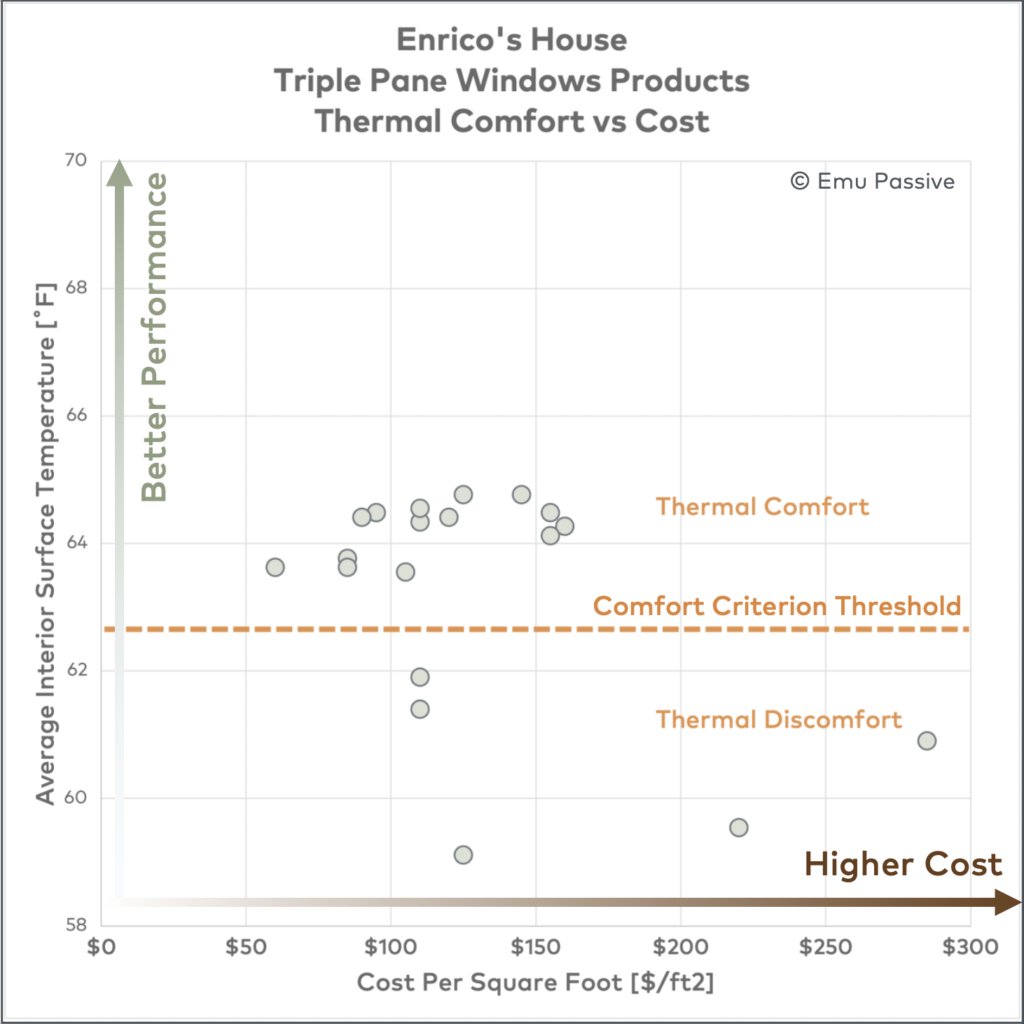
The results of his research revealed two powerful truths about the high performance window market:
- Brand Name and Aesthetics Drive Cost, Not Performance. The two most expensive quotes Enrico received were from well-known, mainstream brands. These windows were significantly more expensive than the competition, yet their thermal performance didn’t even come close to meeting the Passive House Comfort Criterion for his climate.
- For the Same Price, Performance Varies Widely. The data showed a huge range in window performance among products at a similar price point. It proved that you can find exceptional, Passive House-level performance without paying a premium, but you have to know what to look for and prioritize performance over brand recognition.
This is a core part of our mission at Emu: to empower architects, builders, and homeowners with the window building science knowledge to select the best-value components that deliver guaranteed performance and comfort.
Thermal Comfort FAQs
What is thermal comfort?
Thermal comfort is a state of mind that expresses satisfaction with the surrounding thermal environment. It’s more than just air temperature; it involves the absence of unwanted cooling or heating from factors like drafts, cold surfaces (radiant asymmetry), and uneven temperatures from floor to ceiling (air stratification).
How does Passive House improve thermal comfort?
Passive House improves thermal comfort in two main ways: 1) It requires an extremely airtight building envelope, which eliminates cold drafts. 2) It enforces a “Comfort Criterion” that requires high-performance windows and doors, keeping their interior surfaces warm to prevent downdrafts and radiant asymmetry.
What is a high performance window?
A high performance window is designed to have excellent thermal properties, meaning it has a low U-value (resists heat loss) and an appropriate Solar Heat Gain Coefficient (SHGC) for the climate. This often involves triple-pane glass, low-emissivity (low-e) coatings, insulated frames, and inert gas fills like argon or krypton.
Do all Passive House projects need triple-pane windows?
No. The window performance required depends on the local climate. While mixed and heating-dominated climates (US climate zone 4 and above) typically need triple-pane windows to meet the Passive House Comfort Criterion, projects in warmer climates US climate zones 1 and 2) can often use high-quality double-pane windows.
What is radiant asymmetry?
Radiant asymmetry is the thermal discomfort felt when one surface in a room (like a cold window) is significantly colder than the other surfaces. Your body radiates heat towards the cold surface, creating a chilling sensation even if the room’s air temperature is warm.
What is a downdraft?
A downdraft is a current of cold air created when warm indoor air cools against a cold surface, like a poor-quality window. This cooled, denser air then drops to the floor, causing chilly drafts and uncomfortable temperature differences in a room.