When planning a high-performance building or a Passive House project (whether Phius or PHI), you will inevitably face complex decisions regarding your building components. A common assumption in the construction industry is that the cost and performance of building materials always align perfectly. Many people believe that paying a premium price automatically guarantees a superior product. However, our extensive experience at Emu Passive shows that cost and performance are not always directly tied to one another.
This disconnect between price and quality applies across the board. You will see it in commercial projects as well as residential ones, and it affects both new construction and deep energy retrofits. To illustrate this reality, we need to look at one of the most critical and expensive components of any building envelope: the fenestration package.
Fenestration includes all the glass elements of your building—windows, exterior doors, skylights, and curtain walls. Throughout this page, we will refer to all these elements simply as “windows.” By examining a real-world case study, we can conduct a thorough window cost vs performance analysis that reveals why paying more does not always mean getting more.
Demystifying Window Performance and Cost
Based on the extreme efficiency required of window elements in Passive House projects, you might assume they are always the most expensive items on your budget. While high-performance windows do require a solid investment, especially in cold climates, the inverse is not automatically true. An expensive window package does not necessarily mean you are buying a high-performance product.
To be suitable for Passive House certification and high-performance building standards, windows must comply with strict criteria. They have to guarantee exceptional thermal comfort, preventing the cold drafts that typically roll off standard glass. They also must perform flawlessly regarding hygiene criteria, specifically the complete avoidance of mold and condensation on the interior frames and glass edges. Because windows are essentially holes in your heavily insulated walls, they act as the weakest link in your thermal envelope. This makes them one of the most critical components of a Passive House building.
When you set out to run a fenestration performance compare exercise, how exactly does performance relate to cost? To answer this, we have a clear, documented example featuring the personal house project of Enrico Bonilauri, Co-Founder and CEO of Emu Passive.
Case Study: A Deep Dive into Window Cost Comparison
Enrico designed his personal home in the mountains of Colorado. The project sits at a staggering 8,800-foot elevation. This places the site in an Alpine climate zone (Climate Zone 7). In such a harsh, freezing environment, thermal comfort is not just a luxury; it is the highest priority for the entire project.
When approaching the window performance compare process, the design team established clear priorities for the fenestration package:
- Overall Aesthetics: The building needed to look like a modern mountain cabin, blending seamlessly with the surrounding landscape.
- Window Aesthetics: The design called for corner windows at all four corners of the building, placed on different levels. This strategy opens up the architectural “box,” following one of Frank Lloyd Wright’s classic design principles.
- Upfront Cost, Maintenance, and Performance: The team decided to completely avoid lift-and-slide doors, as they often present long-term airtightness and maintenance challenges. Instead, the design relied entirely on high-performance swing doors and tilt-and-turn windows.

The Quoting Process: Gathering Data for a Fenestration Cost Compare
To conduct a truly comprehensive fenestration cost comparison, Enrico requested quotes from 25 different window manufacturers. Ultimately, the team received 19 detailed quotes.
The pool of manufacturers represented a wide spectrum of the market. Several companies offer officially certified Passive House windows. However, the team also included about half a dozen mainstream American window manufacturers in the quoting process, such as Andersen, Loewen, Marvin, Pella, and Sierra Pacific. While these mainstream brands do not offer officially certified Passive House windows, they do provide triple-pane window options. Triple-pane glazing is an absolute necessity to meet the project’s thermal comfort goals in the severe cold of the Colorado mountains.
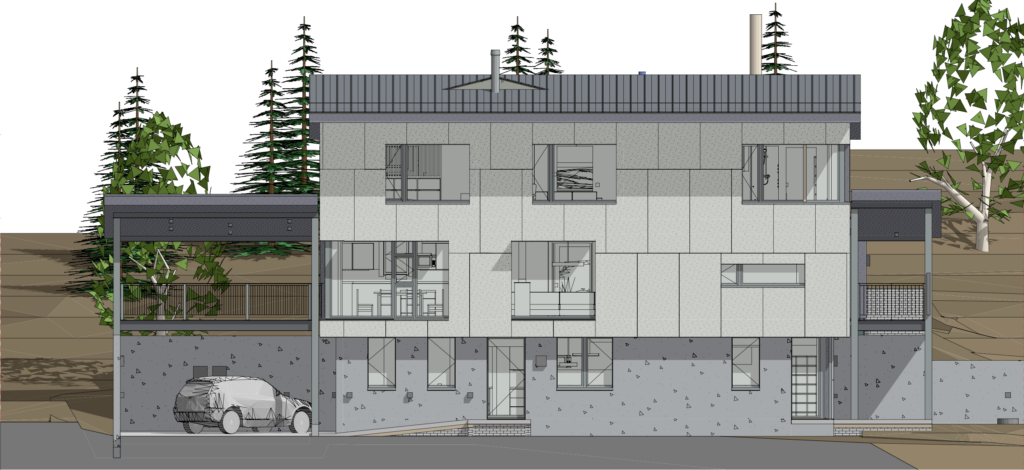
Given the modern mountain cabin aesthetic, most of the window products quoted featured wood frames with exterior aluminum cladding. To ensure a well-rounded window cost compare exercise, the team also included five uPVC products and one thermally broken aluminum product in the review process.
We knew anecdotally that we would uncover massive discrepancies across the quotes. To manage this, we provided all manufacturers with highly specific performance specifications. Once the quotes arrived, we reviewed the data meticulously on a unit-by-unit basis.
Key Observations: The Reality of Window Performance Comparison
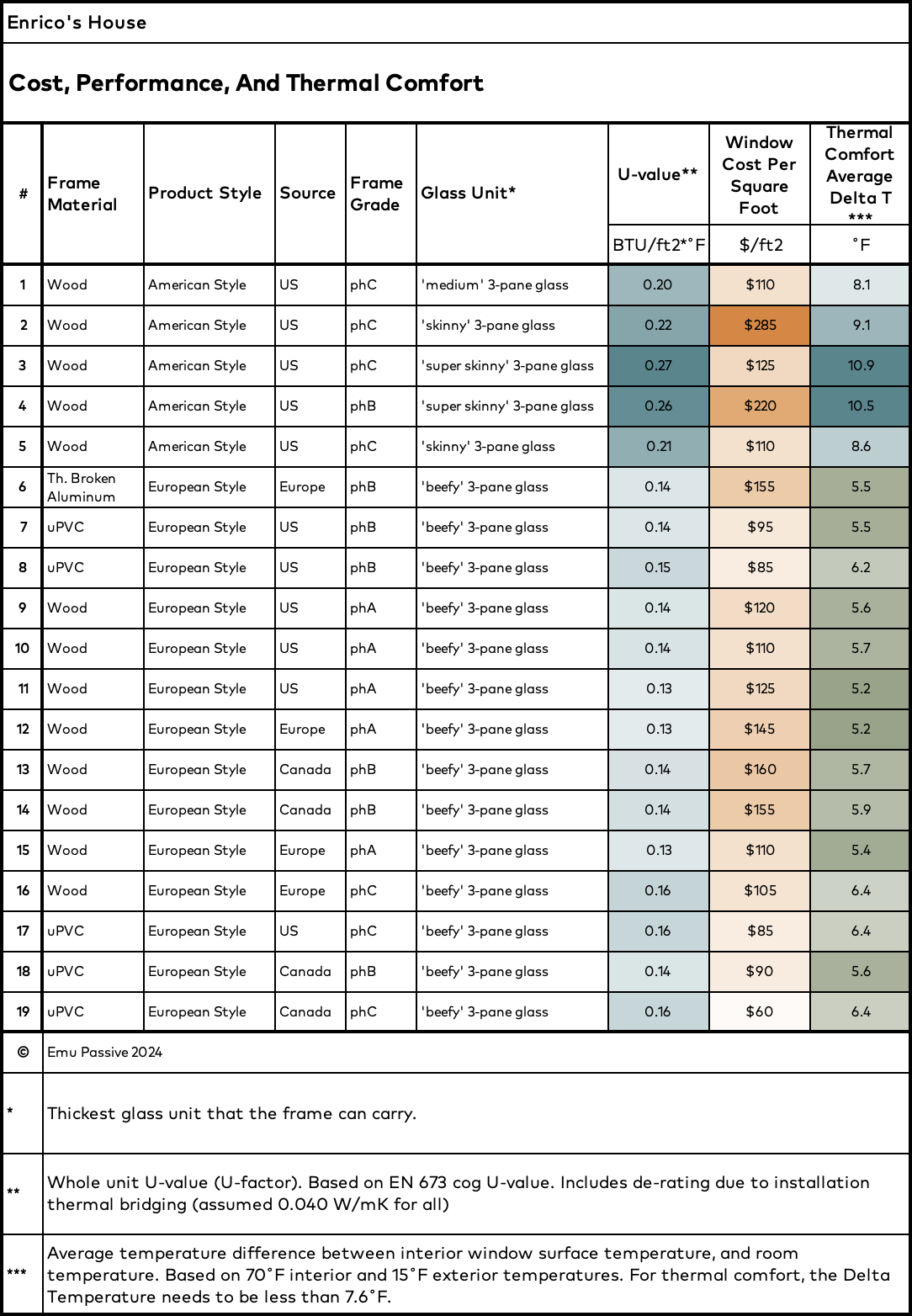
When you line up 19 different quotes for the exact same building, the data tells a fascinating story. Our window performance comparison revealed several critical lessons for anyone building a high-performance structure.
1. Detailed Specifications Are Non-Negotiable: The higher the performance you require, the more detailed your project specifications must be. You cannot simply ask for “good windows.” You must define the exact thermal metrics required. Consequently, the more detailed your specs, the more accurate and rigorous your review of the quotes must be.
2. The Challenge of Rating Systems: As expected, we ran headfirst into the challenge of comparing North American NFRC performance data with European ISO 10077-2 and EN673 data. These two systems calculate window performance differently. We designed our specifications to translate consistently across both rating systems. This ensured we could compare the end results as apples-to-apples. However, we acknowledge that translating these metrics involves a significant learning curve for first-time specifiers and estimators.
3. Massive Performance Variability: When we looked at the window performance and cost, the variance in actual performance was staggering. The quoted window packages varied from a whole-window average R-value of R-3.7 (the worst-performing package) to R-7.8 (the best-performing package). This represents roughly a 1:2 variability in thermal performance across companies claiming to offer high-efficiency products.
4. Extreme Cost Variability: If you want to see why you must run a window cost comparison, look at the bottom line. The lowest quote we received for the entire window package was approximately $47,000. The highest quote came in at an astonishing $241,000. The variability in total cost was a ratio of 1:5.
5. The Single Unit Discrepancy: One of the most striking outcomes of our fenestration cost compare involved a single, large fixed window unit measuring 8 feet by 8 feet. Manufacturers quoted this exact same unit for as low as $1,700 and as high as $25,500. That is a 1:14 cost variability for a single piece of glass and frame. Notably, both the highest and lowest prices came from mainstream American manufacturers, and neither of their products came close to the thermal performance needed for this specific Alpine project. The products that actually suited the performance requirements for this specific unit landed in the much more reasonable $3,000 to $4,500 price range.
Analyzing the Data: Fenestration Cost vs Performance
To make sense of the data, we plotted the results on a graph. We tracked the cost per square foot of the window package along the horizontal axis. On the vertical axis, we tracked the calculated average temperature over the interior surface of the windows.
We calculated this interior surface temperature using climate-specific conditions – specifically, the average temperature of the 12 coldest consecutive hours of the year at the Colorado site. We combined this local climate data with the window’s installed U-value, which carefully accounts for the thermal bridging that occurs during installation.
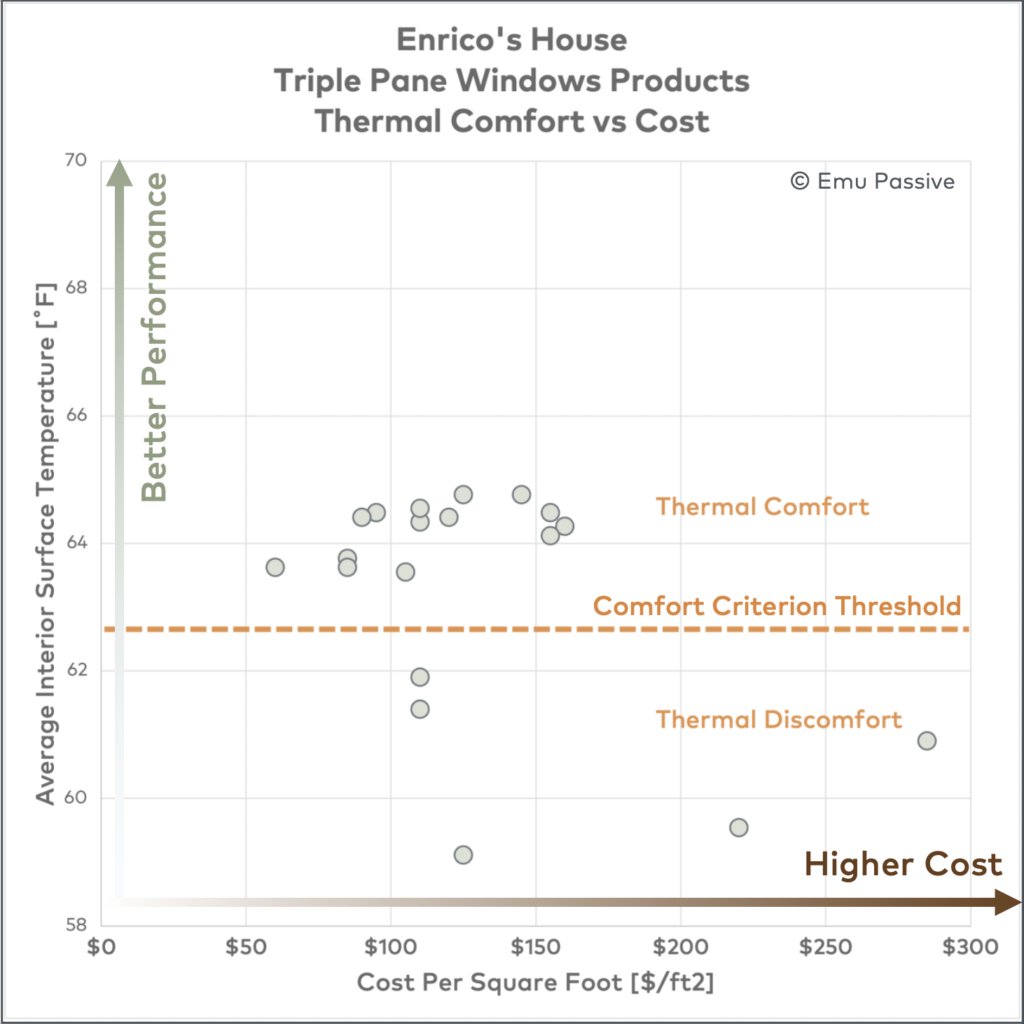
When you look at fenestration cost vs performance on a graph, two glaring truths emerge:
The Most Expensive Options Failed
The two most expensive products quoted did not actually meet the thermal performance requirements for this harsh Alpine location. This definitively proves that cost and performance are not directly related. Paying a quarter of a million dollars for windows does not guarantee they will keep you warm in a blizzard.
Huge Variance Within the Same Price Bracket
Even when you look at products in the exact same cost range, you find massive variability in performance. For example, when looking strictly at windows priced between $110 and $120 per square foot, the resulting interior surface temperatures ranged from a chilly 59˚F to a highly comfortable 65˚F. If you do not perform a thorough fenestration performance compare, you could easily spend $120 per square foot and end up with cold, drafty windows.
Conclusions on Specifying High-Performance Windows
When you embark on a high-performance build, you cannot rely on brand names or high price tags to guarantee success. Our deep dive into window performance and cost yields two fundamental conclusions that should guide your procurement process.
- The more advanced your project goals are, the more advanced your project specifications need to be. You cannot hand a standard window schedule to a manufacturer and expect them to deliver Passive House performance. You must define the metrics, and you must review the incoming bids with intense scrutiny.
- Higher cost does not naturally correspond to higher performance. When you see an exceptionally high quote, it often signals that you are pushing the boundaries of what that specific company can comfortably offer. The exorbitant price may reflect their internal risk, custom manufacturing challenges, or lack of experience with high-performance metrics, rather than the actual quality of the product they intend to deliver.
By taking a diligent, data-driven approach to your window cost vs performance analysis, you can secure the right materials for your climate without blowing your project budget.
For an in-depth comparison of Passive House standards and building codes, review the Emu Report on Building Standards.
Windows and Fenestration: Cost vs Performance Comparison FAQs
What does fenestration mean in construction?
Fenestration refers to all the glass elements and openings in a building’s envelope. This includes standard windows, exterior doors, skylights, and curtain walls. In high-performance building, the fenestration package is critical for maintaining thermal boundaries.
Is a more expensive window always better for a Passive House?
No. A thorough window cost comparison shows that cost and performance are not always directly tied together. Some of the most expensive window packages on the market fail to meet the strict thermal comfort and hygiene criteria required for Passive House certification in cold climates.
Why is a window performance compare necessary for custom builds?
Comparing window performance is necessary because variability is massive. Even within the same price bracket (e.g., $110-$120 per square foot), one window might maintain a comfortable interior surface temperature of 65˚F, while another drops to a drafty 59˚F. Comparing data ensures you get the performance you are paying for.
How do you accurately run a fenestration cost compare?
To accurately compare fenestration costs, you must provide detailed, identical performance specifications to all quoting manufacturers. You then must review the quotes unit-by-unit, ensuring you understand how to translate different rating systems (like North American NFRC and European ISO/EN standards) into an apples-to-apples comparison.
Why do some mainstream windows cost so much but perform poorly in extreme climates?
When a manufacturer quotes an exceptionally high price for a product that still underperforms, it often means the project requirements push the boundaries of their standard capabilities. The high cost reflects their manufacturing inefficiencies or perceived risk rather than superior thermal performance.
What is the relationship between fenestration cost vs performance?
The relationship is non-linear. While you generally must spend a certain baseline amount to achieve Passive House performance, spending significantly beyond that baseline does not guarantee better performance. Proper specification and data analysis matter far more than the total price tag.