We offer comprehensive advanced building science training to help you master high-performance construction. Once you understand the fundamental concepts, you need focused, practical knowledge to tackle complex design and building challenges. Our programs deliver exactly that. Whether you want to watch an advanced building science webinar from your office or book a specialized Passive House training session for your team, we provide the resources you need to build better.
These standalone presentations act as powerful extensions to our core Passive House Training Curriculum. You can take them independently to fill specific knowledge gaps, or you can use them to build upon the strong foundation you established during our boot camps.
Earning your required professional units is simple with Emu. Our advanced Passive House training modules provide continuing education credits for both PHI and AIA. You can read the full details about maintaining your professional credentials on our Continuing Education page.
Building Science Webinar Catalog
Explore our catalog of advanced Passive Building training options below. We structured this section as an FAQ to help you quickly find the right specialized building science training for your specific goals.
What advanced Building Science training do we offer?
We regularly host accessible, high-quality sessions to introduce you to critical performance concepts. If you want a quick dive into an advanced Passive House webinar without the upfront cost, check out our Free Passive House Education page. These standalone presentations cover essential topics and give you a clear preview of our teaching style.
How do the on-demand webinars work?
Our on-demand library features specialized building science webinar recordings that you can watch at your own pace. You get immediate access to advanced Passive Building webinar content covering complex topics like thermal bridge modeling, advanced airtightness strategies, and specific moisture management techniques. Every specialized Passive House webinar in our library functions as an independent, deep-dive lesson.
Can we schedule a Lunch & Learn presentation for our firm?
Absolutely. We can bring specialized building science training directly to your architectural firm or construction team. Our Lunch & Learn sessions offer an excellent way to earn AIA credits together. You get the benefit of an advanced building science webinar formatted specifically for a collaborative group setting.
Are these sessions right for me if I haven't taken Emu's Core Curriculum?
Yes. Every specialized Passive House training session we offer is a standalone module. While they serve as great extensions to our main boot camps, you do not need prior Emu coursework to understand and benefit from this targeted material.
Take the next step in your professional development. Choose a presentation from our catalog above and expand your high-performance building expertise today.
Specialized Building Science Webinars
[001] Intro to Passive House
The Passive House standards represent the world’s most rigorous, proven, performance-based energy efficiency methodology for buildings. This presentation will define the standard’s core metrics and explore the five fundamental physical principles—thermal bridge-free design, superior insulation, high-performance windows, airtightness, and heat recovery ventilation —that allow structures to drastically reduce heating and cooling energy demand.
Participants will learn how achieving these rigorous standards translates directly into superior thermal comfort, greater indoor air quality, increased building durability, and improved climate resilience.
The presentation will conclude by showcasing the versatile application of the standards across residential, multi-family, commercial, institutional, and deep energy retrofit projects.
Learning Objectives
- Identify the five core building science principles required to meet the Passive House standard, and quantify the significant reduction in heating and cooling energy demand resulting from these principles.
- Explain how the construction of an airtight, thermal bridge-free envelope combined with high-efficiency heat recovery ventilation ensures consistent interior surface temperatures and the continuous delivery of filtered fresh air, critically improving thermal comfort and indoor air quality for occupant health.
- Analyze the link between thermal bridge-free and airtight construction techniques and long-term building durability, demonstrating how the elimination of moisture pathways prevents condensation, mold growth, and subsequent material degradation.
- Determine appropriate applications for the Passive House standard—including new construction, multi-family housing, and deep energy retrofits —justifying the selection based on criteria like energy cost reduction, enhanced building resilience during power outages, and overall occupant safety.
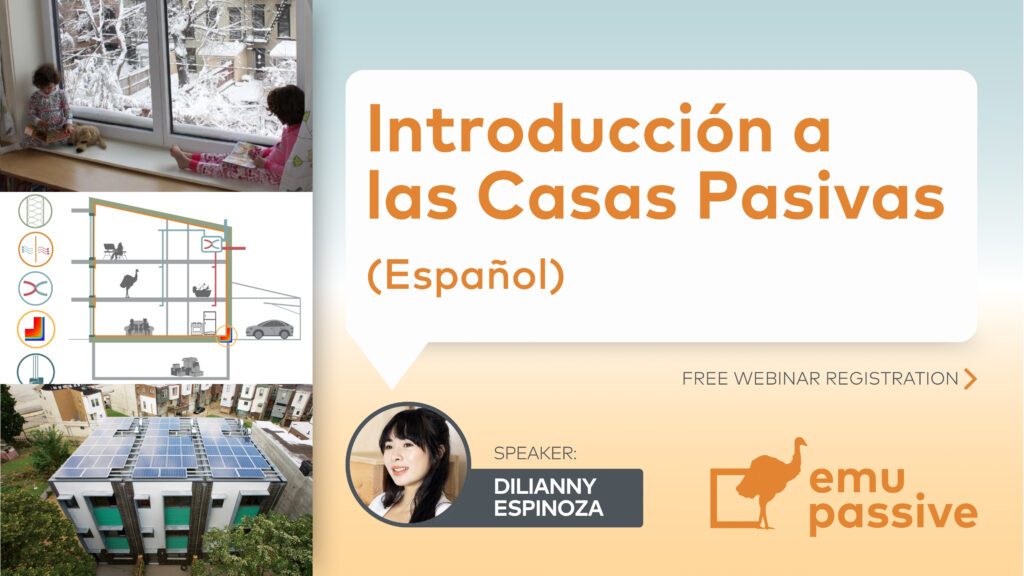
[001E] Introducción a las Casas Pasivas (Estándar Passivhaus)
Los estándares de las Casas Pasivas (Passivhaus) representan la metodología de eficiencia energética para edificios más rigurosa, probada y basada en el rendimiento del mundo.
Esta presentación definirá los parámetros centrales del estándar y explorará los cinco principios físicos fundamentales (diseño sin puentes térmicos, aislamiento térmico continuo, ventanas de alto rendimiento, hermeticidad al aire y ventilación mecánica con recuperación de calor) que permiten a las edificaciones reducir drásticamente la demanda de energía para calefacción y refrigeración.
Los participantes aprenderán cómo el cumplimiento de estos rigurosos estándares se traduce directamente en un confort térmico superior, mayor calidad del aire interior, mayor durabilidad del edificio y una mejor resiliencia climática.
La presentación concluirá mostrando la versátil aplicación del estándar en proyectos residenciales, multifamiliares, comerciales, institucionales y de rehabilitación energética profunda (EnerPHit).
Objetivos de aprendizaje
- Identificar los cinco principios básicos de la física de la construcción necesarios para cumplir con el estándar de las Casas Pasivas y cuantificar la reducción significativa en la demanda energética para calefacción y refrigeración derivada de su aplicación.
- Explicar cómo una envolvente hermética y libre de puentes térmicos, combinada con un sistema de ventilación mecánica con recuperación de calor de alta eficiencia, garantiza temperaturas interiores estables y un suministro continuo de aire fresco filtrado, mejorando de forma crítica el confort térmico y la calidad del aire interior.
- Analizar la relación entre las técnicas de construcción herméticas y sin puentes térmicos y la durabilidad a largo plazo del edificio, demostrando cómo la eliminación de vías de humedad previene la condensación, el crecimiento de moho y la degradación de los materiales.
- Determinar las aplicaciones adecuadas del estándar Passivhaus, incluyendo nueva construcción, vivienda multifamiliar y rehabilitaciones energéticas profundas, justificando su selección en función de criterios como la reducción de costes energéticos, la resiliencia del edificio ante cortes de energía y la seguridad y confort de los ocupantes.
[002] Building Efficiency In The Time Of Electrification - The Passive House Angle
It takes the same amount of energy to A) power a home built to the regular Energy Code, or to B) power a Passive House, and charge two electric vehicles. This is one of the most compelling results from Emu’s “Report On Building Standards”.
This presentation summarizes the why Passive House is even more relevant in the time when both buildings and vehicles are converging towards electrification.
Thermal comfort, indoor air quality, resilience and durability, energy efficiency, and embodied carbon are the metrics that Emu’s research investigated over 50 single family home projects across the US.
Both Phius and Passive House International standards were looked into as part of the research, as well as the “regular” energy Code (IECC), EnergyStar, Zero Energy Ready Home, and Pretty Good House.
With the wider adoption of electric vehicles, and different sectors converting themselves to being all-electric, super-efficient buildings can play a crucial role in this energy transition.
Learning Objectives
- Understand the Energy Impact of Passive House Design – Explain how Passive House standards compare to traditional Energy Code-built homes in terms of energy consumption, particularly in the context of increasing electrification.
- Analyze Key Performance Metrics in Building Standards – Identify and evaluate the importance of thermal comfort, indoor air quality, resilience, durability, energy efficiency, and embodied carbon in sustainable home construction.
- Compare Various Building Standards – Differentiate between Phius, Passive House International, IECC, EnergyStar, Zero Energy Ready Home, and Pretty Good House in terms of their energy efficiency and sustainability goals.
- Recognize the Role of Buildings in the Electrification Transition – Discuss how energy-efficient buildings contribute to the broader transition towards an all-electric future, especially with the increased adoption of electric vehicles.
[003] Unlocking the Value of Passive House: A Data-Driven Comparison
Understanding Passive House performance is key to demonstrating its value beyond energy efficiency—offering superior comfort, air quality, and durability. But with multiple standards in North America, how do they compare?
This presentation analyzes 50 single-family projects across diverse U.S. climates, from humid Texas to the frigid Rockies. It compares Passive House standards against local energy codes, examining both prescriptive and performance-based approaches.
Looking ahead, the study also explores future energy demand, factoring in an electric vehicle-dominated market. The findings reinforce one clear takeaway: cutting building energy use is essential for a sustainable future.
Learning Objectives
- Compare Passive House Standards – Analyze key differences between Passive House certification programs in North America and how they perform relative to local energy codes.
- Evaluate Energy Performance – Examine real-world data from 50 single-family homes across diverse climates to assess energy efficiency, comfort, and air quality benefits.
- Assess Future Energy Demand – Explore how Passive House design prepares buildings for future energy needs, including the impact of widespread electric vehicle adoption.
- Support Sustainable Design – Identify strategies to reduce building energy consumption and enhance resilience, contributing to a more sustainable built environment.
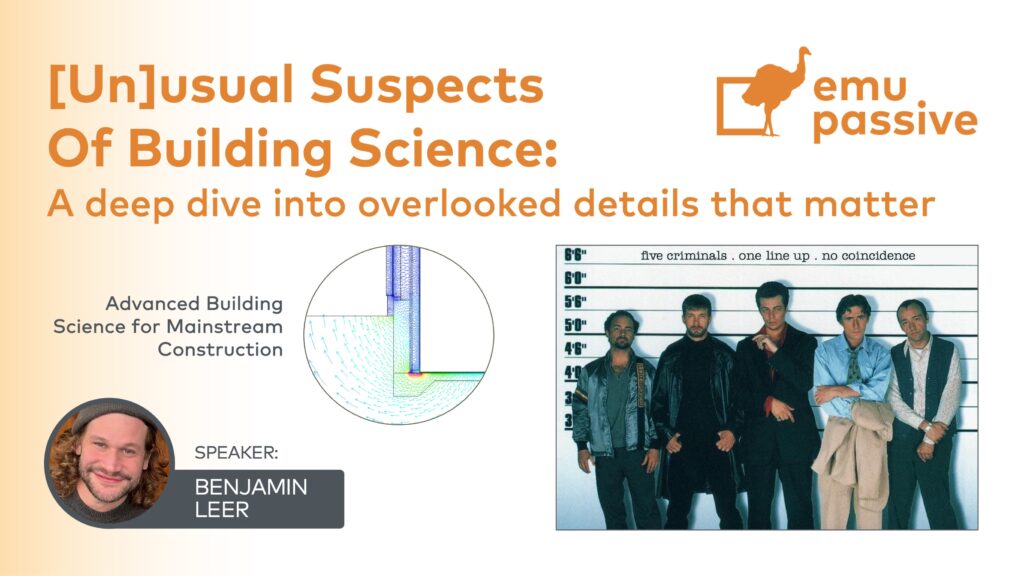
[004] [Un]usual Suspects Of Building Science: a deep dive into overlooked details that matter
In the world of building science, not everything is as it seems. “[Un]usual Suspects of Building Science: A Deep Dive into Overlooked Details That Matter” takes a closer look at the hidden culprits that can undermine the performance, durability, and safety of buildings. Much like the twists and turns of a classic mystery, this presentation uncovers the often-overlooked details—such as window performance, thermal bridging, and moisture management—that can make or break a project. With a focus on the building envelope, attendees will explore how these “suspects” impact health, safety, and wellness, as well as energy performance and cost-effectiveness. Through engaging case studies, practical solutions, and a touch of cinematic flair, this session equips design and construction professionals with the tools to identify and address these critical issues, ensuring buildings that are resilient, efficient, and comfortable.
Learning Objectives
- Analyze the impact of overlooked details, such as thermal bridging and moisture management, on the long-term durability and safety of the building envelope, ensuring protection against material degradation and structural failure.
- Identify high-risk conditions for mold, condensation, and poor indoor air quality, and apply strategies to mitigate these risks through effective detailing and product selection.
- Investigate how key design elements, such as high-performance windows and airtight construction, contribute to thermal comfort, energy efficiency, and occupant well-being across diverse climate zones.
- Compare products, materials, and construction details to avoid performance gaps and develop practical, budget-conscious solutions that meet rigorous energy and performance standards.
[005] The Cornerstones Of Thermal Comfort: High Performance Windows
Windows and exterior doors play a key role in the success of any project. They open up the building to daylight and exterior views, and allow for natural ventilation. They are a key factor in a building energy balance, and can provide free heating via passive solar gains.
They are also one of the most expensive line items on a project budget, and can cause serious problems if not chosen wisely, or installed poorly.
Many associate windows with water leaks, condensation, and install issues. In high performance construction and Passive House, the list of risks grows further and includes air leaks, overheating, wrong selection of key components (e.g. glass spacers and low-e coatings, to name a couple), and of course over-spending.
This presentation illustrates climate-specific goals and solutions in selecting the right package for windows and exterior doors. Different products are compared in terms of performance and cost-effectiveness, and best practices for install details are illustrated side by side with their energy analysis.
Learning Objectives
- Learn about climate-specific requirements for windows and exterior doors with regards to thermal comfort, condensation avoidance, and energy and daylight performance.
- Evaluate the impact of different components of windows and doors on their overall performance.
- Review non-conventional install details that are used in Passive House and high performance construction to maximize performance and thermal comfort.
- Compare product prices and their performance, and learn how these are not always tightly linked.
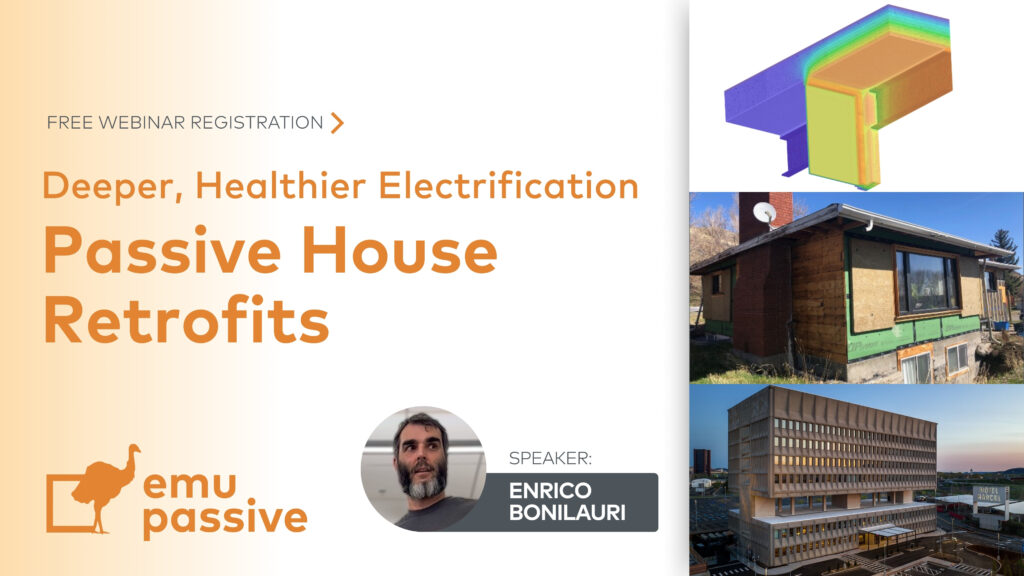
[007] Deeper, Healthier Electrification: Passive House Retrofits
Electrifying existing buildings is a crucial step toward reducing reliance on fossil fuels, but it introduces certain challenges. These include the risk of diminished resilience in the built environment during power outages and increased costs for backup power solutions.
This presentation explores how integrating Passive House standards into building retrofits can enhance both energy efficiency and resilience. It highlights the long-term benefits of these standards, not only in improving a building’s ability to withstand power disruptions, but also in boosting occupant comfort, health, and overall quality of life.
Learning Objectives
- Analyze how Passive House airtightness and mechanical ventilation improve occupant health by ensuring continuous fresh air and reducing indoor air pollutants.
- Evaluate how the highly insulated Passive House envelope increases building safety by maintaining habitable temperatures and resilience during prolonged power outages.
- Explain how Passive House super-insulation and thermal bridge mitigation contribute to occupant wellbeing by mitigating the risk of mold and condensation, and maximizing thermal comfort.
- Describe strategies for integrating high-efficiency heat pumps into Passive House retrofits to achieve optimal energy performance and long-term cost savings.
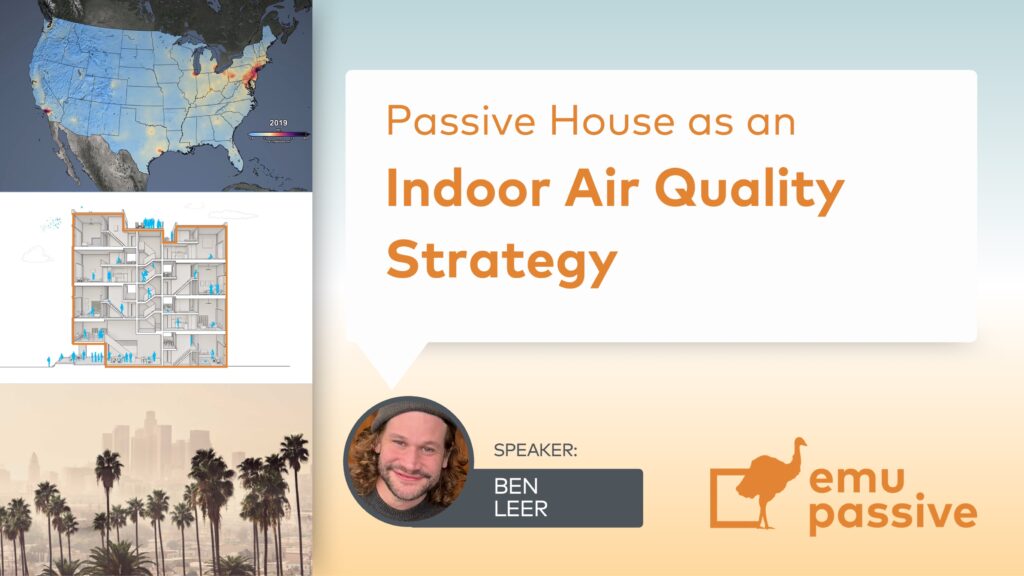
[008] Passive House As An Indoor Air Quality Strategy
Passive House standards are widely recognized as the gold standard for building energy efficiency. However, focusing solely on energy savings overlooks one of their greatest benefits: significantly enhanced indoor air quality.
This presentation delves into various indoor air quality metrics and demonstrates how Passive House standards surpass code-minimum construction in improving these factors. By combining superior air tightness with a continuous supply of filtered, fresh air, Passive House buildings achieve markedly healthier living environments. This applies not only to new builds but also to retrofit projects, offering long-term benefits for occupant well-being and comfort.
Learning Objectives:
- Understand the key principles of Passive House standards and their role in enhancing building energy efficiency and indoor air quality.
- Identify and explain key indoor air quality metrics that are significantly improved by Passive House standards, beyond energy savings.
- Compare Passive House construction to code-minimum standards in terms of air tightness and the continuous supply of filtered fresh air for healthier indoor environments.
- Evaluate the long-term benefits of Passive House principles for occupant well-being and comfort, both in new builds and retrofit projects.
[012] Dude, Where’s My Carbon? The Hidden Impact of Building Materials - Analyzing embodied carbon in Passive House design
This presentation explores the often-overlooked impact of embodied carbon in Passive House construction. While Passive House design dramatically reduces operational energy, it can sometimes involve material choices that carry a high carbon footprint.
The presentation will break down what embodied carbon is, how it contributes to a building’s life-cycle emissions, and how to balance low-energy performance with low-carbon material strategies. The presentation builds on research from a CCNY Sustainability in the Urban Environment Master’s thesis that compares building energy standards and quantifies both embodied and operational carbon, drawing from real-world insights gained through Emu Passive’s certified projects.
The session bridges academic research and practical experience to explore how smarter material choices and design decisions can lead to more holistic, climate-conscious solutions in high-performance building.
Learning objectives:
- Understand the definitions of embodied carbon and operational carbon, and their impact on COâ‚‚ emissions.
- Assess different building materials in the context of embodied carbon and their contribution to a building’s life-cycle emissions.
- Evaluate the trade-offs between embodied carbon and operational carbon across various building energy standards.
- Apply strategies to reduce embodied carbon in Passive House and high-performance building design.
[013] Passive House Construction Details
This presentation provides an in-depth exploration of developing Passive House-level construction details for commercial, residential, and retrofit projects, with a focus on health, safety, and wellness. It is structured around the integrated design and construction of the four primary control layers: structural, water, thermal, and air. Attendees will learn how to strategically merge these layers to create buildings that are energy-efficient, resilient, and promote superior occupant health and comfort. The session emphasizes strategies to prevent mold, condensation, and material degradation, ensuring a durable and healthy building envelope across diverse American climate zones.
Through case studies and detail analysis, the presentation addresses practical execution challenges, including achieving durable air sealing, managing moisture loads, and understanding drying potential as critical components of long-term building health and safety. Attendees will gain actionable knowledge to design and construct high-performance buildings that meet rigorous Passive House standards while balancing project-specific goals, cost-effectiveness, and construction logistics.
Learning Objectives
- Analyze the integrated role of the four primary control layers (vapor, water, thermal, and air) in Passive House design to prevent material degradation, manage moisture, and ensure a durable building envelope across diverse climate zones.
- Identify high-risk conditions for mold and condensation within complex building details and apply air sealing and vapor management strategies to mitigate these risks, ensuring superior indoor air quality and occupant wellness.
- Develop detailing strategies to manage varying thermal and moisture loads, emphasizing the avoidance of mold, condensation, and thermal stress to create safe and resilient buildings.
- Design robust, buildable construction details that maintain continuity of the air and thermal control layers, balancing work sequencing, cost-effectiveness, and quality assurance to achieve certified Passive House performance levels.
[014] Strong Foundations: Passive House Details At and Below Grade
While most Passive House discussions focus on walls and windows, the foundation is where the building meets the unforgiving reality of ground physics. This presentation explores the hygrothermal relationship between the structure and the earth, debunking the common myth that the ground is a stable, infinite heat sink.
We will navigate the technical challenges of sub-slab insulation, thermal bridge-free transitions, and moisture management, comparing strategies for new builds versus the “surgical” complexity of retrofits (EnerPHit). Beyond energy, we will address critical site-specific durability issues—including radon mitigation, termite protection, and the structural risks of expansive soils—to ensure the building’s foundation is as high-performing as its superstructure.
Learning Objectives
- Analyze the mechanisms of heat and moisture transport between the building and the soil, and explain why relying on “average” ground temperatures can lead to inaccurate energy modeling and potential health risks.
- Identify and implement design solutions for sub-grade risks, including radon-safe soil gas venting, termite barriers in foam insulation, and strategies to address expansive or frost-heave-prone soils, ensuring occupant safety and structural integrity.
- Evaluate and select climate-specific foundation assemblies, such as raft slabs or insulated strip footings, to address varying environmental conditions and the unique constraints of new construction versus below-grade retrofits.
- Solve Foundation Thermal Bridges: Demonstrate how to maintain a continuous thermal and airtight layer at the critical wall-to-foundation junction to prevent condensation, mold, and energy loss.
[015] Natural Crossovers: Combining Passive House Building Science and Biogenic Materials to deliver exceptionally healthy, resilient buildings
This presentation illustrates the opportunity to integrate biogenic building products, non-mainstream construction techniques, and Passive House building science as a means to enhance occupants health as well as building resilience and durability.
The mainstream American construction industry fails to deliver high quality buildings, due to swings in political will, snail-paced building code improvements, as well as concerning voids in the regulations of many aspects of health, comfort, and durability in buildings.
As a result, even buildings that are brand new can expose occupants to harmful chemicals, mold and condensation issues, and uninhabitable living conditions.
As an example, the obsolete building science at the basis of building code favors spray foam and vapor-close building assemblies. Consequently, buildings result less resilient in regard to moisture dynamics, which undermines their overall durability. Along the same lines, the lack of progress around building envelope performance leaves new buildings to still heavily depend on active heating and cooling to stay comfortable. For this reason, when significant power outages occur, this lack of thermal resilience leads these buildings to quickly become uninhabitable.
The combination of biogenic construction materials and building products, and the building science of Passive House, provide a powerful alternative that can overcome the issues faced by mainstream construction. While these currents of the green building world often run parallel to, and independent from, one another, they don’t exclude each other. On the contrary, they can be successfully combined, with the result being exceptionally healthy and resilient buildings.
The cross-over between Passive House building science and biogenic materials provides unprecedented opportunities for innovative yet surprisingly simple, durable buildings for the twenty-first century.
Learning Objectives
- Review aspects of building code and mainstream construction that are of particular concern with regard to health and durability in buildings.
- Evaluate the metrics used to quantify and qualify different aspects of resilience, comfort, and indoor environmental quality in buildings.
- Analyze the building science tools that Passive House provides to improve on these metrics, with its climate-specific, performance-based methodology.
- Assess how to integrate the Passive House methodology using non-mainstream construction techniques and biogenic materials.
[016] Passive House Products & Components: High-Performance Selection Across Climate Zones
Designing a high-performance building goes beyond selecting high-performance materials; it requires a holistic approach that integrates systems and components to create a safe, healthy, and energy-efficient environment.
This presentation explores the technical requirements for products and materials through the lens of the five Passive House principles: super-insulation, thermal bridge-free design, high-performance fenestration, airtightness, and heat recovery ventilation. Attendees will learn how these principles contribute to occupant health, safety, and wellness by improving indoor air quality, managing moisture, and ensuring thermal comfort.
Additionally, the session will examine how climate zone variations influence the performance and necessity of specific components, providing a framework for achieving both certification and project-specific energy goals.
Learning Objectives
- Explain how heat recovery ventilation systems and airtight construction contribute to improved indoor air quality, thermal comfort, and occupant wellness.
- Identify strategies for thermal bridge avoidance and proper material selection to prevent condensation, mold growth, and structural degradation, ensuring long-term building safety and durability.
- Evaluate the role of high-performance fenestration and air barriers in maintaining consistent indoor temperatures, reducing thermal stress, and protecting occupants from extreme climate conditions.
- Analyze how climate zone variations impact the necessity of advanced components (e.g., ultra-low U-value windows) and apply a framework to balance energy performance with project-specific goals.
[030] Passive House Pitch Perfect: Sealing the Deal on High-Performance Buildings
This presentation provides design and construction professionals with the skills to effectively communicate the value of adopting Passive House standards to a variety of stakeholders. It explores how to tailor the pitch to different audience segments, including homeowners, developers, and investors, by highlighting the specific benefits that align with their goals and values.
The session will cover strategies for framing Passive House not just as a green building standard, but as a path to achieving superior comfort, dramatically reduced energy costs, enhanced building durability, and increased property value. Attendees will learn how to articulate the long-term return on investment and market advantages of high-performance buildings, enabling them to confidently champion Passive House on a wider range of residential and commercial projects.
Learning Objectives
- Participants will be able to identify the unique motivations and priorities of clients when considering high-performance building standards like Passive House.
- Participants will be able to articulate the primary benefits of Passive House standards, such as improved indoor air quality and reduced energy consumption, and translate these benefits into tangible value propositions.
- Participants will be able to develop and present a persuasive argument for Passive House by correlating specific strategies (e.g., airtight construction, high-performance windows) with financial, environmental, and health-related benefits.
- Participants will be able to analyze a project’s goals and determine the most effective strategies for presenting Passive House as a solution that aligns with the client’s financial objectives and long-term asset value.
[040] Passive House For Architects
This presentation delivers a focused exploration of the Passive House standard, with an emphasis on its application in both residential and non-residential buildings. Designed specifically for architects, it delves into the five core principles of Passive House—superinsulation, airtightness, thermal bridge-free design, high-performance glazing, and mechanical ventilation with heat recovery—while also addressing key design strategies crucial for successful implementation.
Attendees will gain insights into the impact of form factor on energy performance, how to optimize building orientation, and how to integrate Passive House requirements early in the architectural design process to avoid costly rework later. Special attention will be given to the unique challenges and solutions in non-residential projects, including schools, offices, and commercial buildings, where internal heat gains, occupancy patterns, and ventilation needs differ significantly from residential designs.
Through real-world case studies and actionable guidance, participants will learn how to balance aesthetics, functionality, and Passive House performance to create high-performing, future-ready buildings. This session is ideal for architects seeking to elevate their practice with cutting-edge sustainable design.
Learning Objectives
- Define the five core principles of the Passive House standard and explain how they contribute to building energy performance, occupant comfort, and long-term sustainability.
- Analyze the role of form factor, orientation, and thermal envelope design in achieving Passive House certification, with an emphasis on integrating these strategies into the early stages of architectural design.
- Identify design and technical considerations unique to non-residential Passive House projects, including internal load management, ventilation strategies, and occupant usage patterns.
- Demonstrate how to incorporate Passive House design strategies into diverse architectural typologies while balancing aesthetics, function, code compliance, and constructibility.
[041] Beyond Residential: Designing Non-residential Buildings to Passive House Standards
This presentation offers a deep dive into the application of Passive House principles in commercial building design, highlighting the unique opportunities and challenges that come with scaling high-performance strategies beyond residential contexts. We’ll begin with an overview of Passive House standards—comparing PHI and Phius—and their shared performance-based methodology. Key requirements such as Heating and Cooling Demand, Site and Source Energy Demand, Air Changes per Hour, thermal comfort, and thermal bridge mitigation will be discussed in the context of non-residential projects.
Participants will explore the practical implications of Passive House in commercial typologies including offices, schools, hotels, data centers, and hospitality. We’ll cover design considerations like form factor, thermal bridging, insulation strategies, glass performance (U-values vs. visible transmittance), and interior heat gains. Special attention will be given to nuanced systems like ERVs in commercial settings, air leakage targets.
Through the lens of case studies, we’ll examine how Passive House can meet and exceed regulatory benchmarks while delivering real-world benefits.
Learning Objectives
- Compare Passive House standards (PHI and Phius) and their performance-based methodologies, focusing on how they address energy use, air tightness, and occupant comfort in commercial buildings.
- Describe key Passive House performance requirements — including Heating and Cooling Demand, Air Changes per Hour, Site and Source Energy Demand, and thermal bridge mitigation — as they apply to non-residential typologies.
- Assess critical design strategies for commercial Passive House projects, including form factor optimization, insulation detailing, glazing performance, and indoor air quality management via heat recovery ventilation systems.
- Evaluate real-world case studies to understand how Passive House design can meet regulatory energy codes (e.g., NYC Local Law 97) while improving occupant health, comfort, and operational efficiency in commercial environments.
[042] Passive House and Fire Resilience
More details coming soon.
[043] Passive House Quality Assurance, Testing, and Commissioning
Designing a Passive House is only half the battle; ensuring it performs as modeled requires a rigorous, multi-stage approach to quality control. This presentation dives deep into the “boots on the ground” reality of Passive House construction. We will move beyond theoretical R-values to focus on the practical verification, diagnostic testing, and systems commissioning necessary to achieve certification and long-term building durability.
From managing the complexities of large-scale commercial blower door tests to the precision balancing of Energy Recovery Ventilators (ERVs), this session provides the technical roadmap for turning high-performance designs into high-performance realities.
Learning Objectives
- Master Certification Standards: Identify the specific Passive House requirements for quality assurance (QA), onsite testing, and final commissioning documentation.
- Execute Advanced Air-Leakage Testing: Perform a deep dive into Blower Door Testing protocols, with a specialized focus on the unique challenges and equipment configurations required for large-scale commercial buildings.
- Optimize Ventilation Performance: Understand the step-by-step commissioning process for ERV/HRV systems, ensuring design flow rates, pressure balance, and acoustic requirements are met.
- Implement High-Performance QA: Develop a checklist for critical Passive House site inspections, including the continuity of the air barrier, the integrity of thermal insulation, the installation of thermal breaks, and the precision sealing of high-performance windows.
[044] Passive House Specs Writing and Estimating
This presentation addresses the critical need for architects, specification writers, general contractors, and estimators to translate ambitious Passive House performance goals into actionable, budget-conscious documentation for large-scale multi-family and commercial projects. The session emphasizes how the unique requirements of the Passive House standards necessitate an intimate understanding of climate-specific detailing and performance targets across diverse American climate zones. We will cover how to align project documentation with the required performance and testing protocols (such as blower door testing and thermal bridge verification). The goal is to move beyond conventional specifications to create a project roadmap where every component directly contributes to the building’s certified performance.
The core instruction focuses on methodologies for correctly and thoroughly writing building performance specifications and developing complete and reliable project estimates. This integrated approach is essential for mitigating construction risk. By clearly defining materials, tolerances, and quality control measures up front, teams can ensure the project documentation is thorough and complete, guaranteeing that cost estimates are reliable. This precision in documentation and pricing is the single most effective strategy for dramatically reducing Requests for Information (RFIs), preventing scope creep, and avoiding budget overruns during the complex construction and certification phases of high-performance buildings.
Learning Objectives
- Evaluate the unique performance and testing standards required for Passive House certification in multi-family and commercial projects, distinguishing between prescriptive and performance-based specifications based on the project’s specific climate zone and building type.
- Develop comprehensive, high-performance building specifications that accurately integrate the four control layers (air, thermal, water, and structural) to minimize thermal bridging and ensure long-term building durability and performance.
- Apply best practices in quantity takeoffs and cost estimating specifically tailored for Passive House components and quality control measures to produce reliable project budgets that avoid financial risks associated with incomplete scope definition.
- Analyze and integrate required quality assurance documentation and verification protocols into project specifications to dramatically reduce RFIs and avoid exceeding budget allowances, thereby promoting the complete and thorough documentation required for project success.
[051] Passive House Strategies in Warm, Hot, and Humid Climates
This presentation examines the unique challenges and innovative solutions for implementing Passive House principles in warm, hot, and humid climates. It focuses on climate-specific strategies, including advanced moisture control, optimized ventilation, solar shading, and energy-efficient envelope design, to address the demands of these environments. Through case studies and performance data, participants will explore how Passive House standards can be adapted to enhance occupant health, safety, and wellbeing while achieving durability and energy efficiency in challenging climatic conditions.
Learning Objectives
- Identify the key challenges of designing high-performance buildings in warm, hot, and humid climates, including moisture control, overheating, and indoor air quality concerns.
- Explain how Passive House principles—such as thermal insulation, airtightness, and balanced ventilation—can be adapted to promote occupant comfort and energy efficiency in these climates.
- Evaluate climate-appropriate building envelope strategies, including shading, material selection, and window performance, to enhance durability and reduce thermal gains.
- Apply lessons learned from case studies to inform the design of resilient, low-energy buildings that meet Passive House certification standards in hot and humid regions.
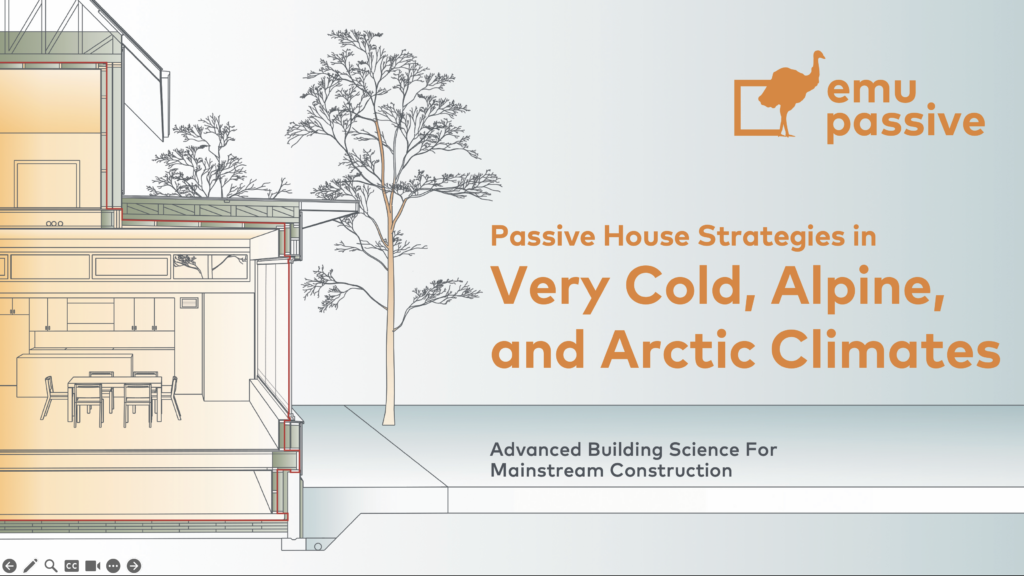
[052] Passive House Strategies in Very Cold, Alpine, and Arctic Climates
This presentation explores applying Passive House building science to create highly durable, energy-efficient, and comfortable structures in very cold, alpine, and arctic climates. The focus is on achieving passive survivability—designing the building envelope to function like a thermos to maintain livable temperatures during a grid failure. This resilience is crucial given that increased electrification can make buildings and the power grid less reliable in harsh conditions. The presentation will show how to achieve greater energy security by minimizing the need for active heating.
A key topic is superior moisture management, detailing specific strategies to prevent high vapor drive from causing condensation and mold in structures with large temperature differences, thereby protecting occupant health and building integrity. We also address the unique construction challenges of high mountain elevations, specifically the risk of insulated glass unit failure due to pressure differentials between manufacturing and installation sites. This presentation provides essential, actionable knowledge for building professionals working in the world’s most demanding thermal environments.
Learning Objectives
- Analyze thermal bridge-free detailing and extreme airtightness to ensure passive survivability and maintain safe indoor temperatures during grid failures in very cold climates.
- Describe moisture management strategies for high-performance envelopes to prevent condensation and mold growth, protecting occupant health and structural durability.
- Evaluate Passive House principles to reduce reliance on active heating, thereby enhancing grid resilience and minimizing exposure to utility failure in harsh conditions.
- Apply best practices for specifying insulated glass units at high elevations, mitigating pressure differentials to ensure long-term performance and structural integrity.
[081] Beyond Energy: Passive House In California
This session explores how Passive House principles are being applied across California’s diverse climate zones—from foggy coastlines to hot inland valleys and desert regions—to create buildings that are energy-efficient, healthy, and climate-resilient. Participants will learn how Passive House design significantly improves indoor air quality through continuous, balanced ventilation with high-performance filtration, making it especially beneficial in areas impacted by wildfire smoke and urban air pollution. The session also highlights how Passive House buildings provide exceptional resistance to heat waves by maintaining thermal comfort with minimal mechanical cooling, thanks to airtight construction, advanced insulation, and passive shading strategies.
In addition, the presentation will cover how Passive House enhances resilience to wildfires, including limiting smoke infiltration through airtight envelopes. Importantly, Passive House is currently being evaluated as an alternative compliance pathway to California’s Title 24 energy code, offering a rigorous, performance-based framework that aligns with the state’s decarbonization and zero net energy goals. Case studies will illustrate successful implementations and the policy potential of Passive House to support a cleaner, safer, and more sustainable built environment in California.
Learning Objectives
- Describe how Passive House strategies improve indoor air quality through airtight construction and high-efficiency ventilation systems, especially in areas affected by pollution and wildfire smoke.
- Analyze the role of Passive House design in enhancing building resilience during extreme heat events and heat waves through passive cooling, insulation, and envelope performance.
- Identify wildfire-specific design measures within Passive House construction that reduce smoke infiltration and ignition risk, contributing to occupant health and building durability.
- Evaluate how Passive House is being considered as an alternative compliance path to California’s Title 24 energy code, and how it aligns with the state’s energy efficiency and climate goals.