When you set out to build or renovate a structure, you face a critical choice about how that building will perform for the next fifty to one hundred years. Many modern construction methods rely on minimum code compliance or offset strategies to achieve their energy goals. However, a growing movement of professionals and building owners is choosing a different, much more effective path: Passive House Standards.
At Emu Passive, we believe that the foundation of any great building lies in its envelope. Passive Building Standards are rigorous, performance-based building standards that prioritize the building envelope first, rather than relying on compensation strategies like traditional Net Zero energy approaches. By focusing on the envelope, we can deliver greater efficiency, superior comfort, and longer-lasting value than any active mechanical system or offset strategy ever could.
While these standards are largely voluntary benchmarks adopted by forward-thinking building owners and project teams, local jurisdictions across the globe are increasingly adopting Passive House Standards as stretch code goals or alternative compliance pathways. This shift represents the future of the construction industry.
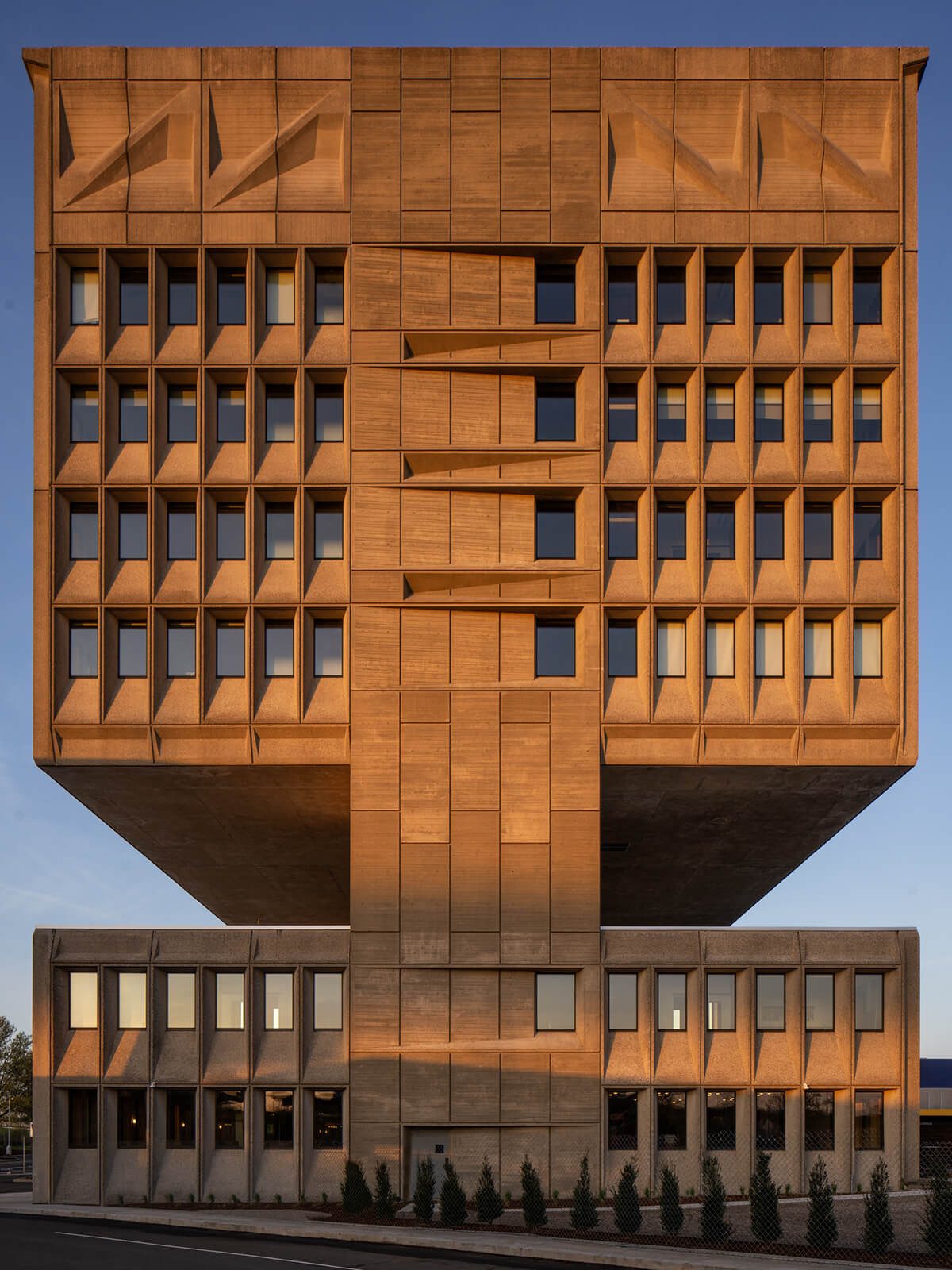
Winthrop Center in Boston, MA. It was the world’s largest certified Passive House building at the time it was completed.
The Global Leaders in Passive Building Standards
To understand the landscape of high-performance building, it helps to know the organizations that define these metrics. The international Passive House Institute (PHI) is the global leader in defining Passive House Standards for new construction and retrofit projects, including commercial and residential builds. PHI sets a rigorous, scientifically backed benchmark that applies to climates all over the world.
In the United States, Phius also offers similar standards. However, it is important to note the performance distinctions between the two. The average performance of a Phius-certified building is generally closer to the metrics of a PHI Low Energy Building rather than a fully certified PHI Passive House. Both organizations push the industry forward, but the international PHI standard remains the ultimate gold standard for building science and thermal performance globally.
Passive House Standards Apply to More Than Just Houses
Passive House standards are not just for homes—they apply to a diverse range of building types well beyond single-family residences. Offices, schools, factories, supermarkets, churches, community centers, museums, and libraries have all been successfully designed and certified according to Passive Building Standards. The envelope-first principles of Passive House are universally scalable and adaptable, making them ideal for commercial, institutional, and public buildings of all sizes and uses. As a result, the influence of Passive House design can be felt across entire communities, demonstrating that superior energy efficiency, comfort, and durability are achievable in virtually any type of structure. Review the international database of Passive House buildings, and explore different building types that can benefit from adopting Passive House standards.
The Envelope-First Approach vs. Offset Strategies
One common factor uniting all Passive Building Standards is the “envelope-first” approach. But what exactly does this mean?
In conventional green building, a popular method to achieve a “green” label is the Net Zero energy strategy. In a standard Net Zero approach, a builder might construct a relatively conventional, code-compliant building that still leaks air and loses significant heat. To make up for this energy loss, they install a massive solar panel array on the roof to offset the energy consumed by the building’s oversized heating and cooling systems. This is a compensation strategy. You are simply generating more energy to cover up the fact that the building wastes energy.
The envelope-first approach flips this concept upside down. Before you even think about adding solar panels or complex mechanical systems, you design the building’s outer shell – the walls, roof, foundation, and windows – to be incredibly efficient. By drastically reducing the amount of energy the building needs to stay comfortable, you can shrink the size of your heating and cooling equipment.
This approach delivers longer-lasting value. Mechanical systems break down, require maintenance, and need replacing every ten to fifteen years. Solar panels degrade over time. But a well-designed, heavily insulated, and airtight wall assembly will perform exactly the same way fifty years from now as it does the day it is built. This is the core philosophy behind Passive House principles.
Passive House: Paving the Way for Sustainable Electrification
A major advantage of Passive House – and Passive Building Standards in general – is their unique role in accelerating sustainable electrification. By dramatically reducing the operational energy required for heating and cooling, Passive House principles allow buildings to easily adapt to all-electric systems without the usual increases in energy demand. The resulting streamlined efficiency means it’s simpler to achieve Net Zero targets: smaller, more affordable renewable energy systems can meet the remaining energy needs of a Passive Building. This outstanding reduction in operational energy use positions Passive House as a cornerstone strategy for those committed to deep decarbonization, resilient energy infrastructure, and a more sustainable built environment.
Cost-Effectiveness in Passive House and High-Performance Projects
An essential advantage of Passive House and high-performance building standards is their inherent cost-effectiveness. The performance-based approach empowers project teams to precisely tailor their buildings to local climate conditions, rather than forcing them through a rigid, one-size-fits-all checklist.
This flexibility not only allows for smarter and more efficient use of resources, but also helps strike the perfect balance between cost and performance, ensuring that investment is directed where it has the greatest impact.
Emu’s research also reveals that cost and performance are not always directly correlated. This insight is underscored by our window cost and performance study on the home of Enrico Bonilauri, Emu Co-Founder and CEO, which illustrated that higher costs do not always guarantee superior performance in critical building components. By focusing on performance-driven decisions, teams can optimize value for both budget and building quality.
The Five Key Passive House Principles
To achieve this incredible level of performance, project teams implement five fundamental Passive House principles. When combined, these five elements create an indoor environment that is draft-free, quiet, and exceptionally comfortable.
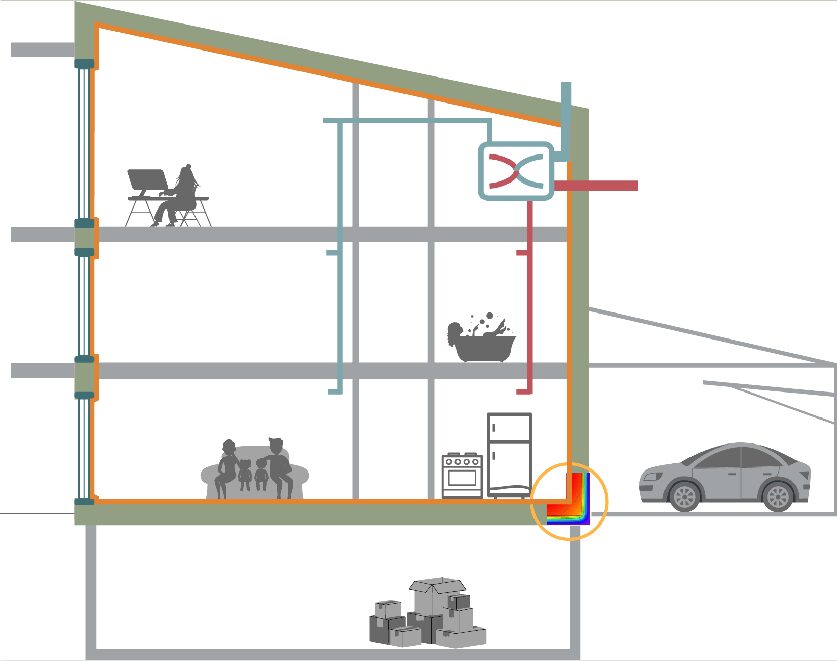
1. Superinsulation
The first of the Passive Building principles is superinsulation. The building envelope must be heavily insulated to prevent heat from escaping during the winter and to keep the heat out during the summer. The exact thickness and type of insulation depend on the local climate. A project in subarctic Alaska will naturally require significantly more insulation than a project in the mild climate of California. However, the goal remains the same: to create a thick, protective thermal blanket around the entire conditioned space of the building.
2. Thermal Bridge-Free Design
Heat is like water; it will always find the easiest path to escape. In a building, these paths of least resistance are called thermal bridges. A thermal bridge occurs when a highly conductive material, such as a steel beam or a concrete balcony slab, penetrates the insulation layer, creating a highway for heat to bypass your thermal blanket. Passive House principles require meticulous design and detailing to eliminate or severely mitigate these thermal bridges. Thermal bridge-free design not only saves energy but also prevents cold spots on interior walls, which in turn eliminates the risk of condensation and mold growth.
3. High-Performance Fenestration
Windows and exterior doors are essentially giant holes in your carefully insulated wall. Therefore, high-performance fenestration is absolutely critical. To meet Passive House Standards, buildings typically utilize advanced window technology. Depending on the climate, this often means triple-pane glass, double low-emissivity (low-e) coatings, argon or krypton gas fills between the panes, and thermally broken window frames. These windows are so efficient that you can sit right next to them during a blizzard and feel absolutely no cold radiating from the glass, and have high thermal comfort.
4. Airtightness
You cannot control the environment inside a building if you cannot control the air moving in and out of it. Superior airtightness is a hallmark of Passive Building Standards. A typical code-built house has hundreds of small cracks and gaps that allow cold drafts to blow in and expensive conditioned air to leak out. Passive buildings use specialized tapes, membranes, and careful construction techniques to create an unbroken airtight layer. This completely eliminates drafts, prevents moisture from traveling into the wall cavities (which causes rot), and keeps outdoor pollutants and allergens outside where they belong.
5. Fresh Air Ventilation with Heat Recovery
If a building is airtight, how do the occupants breathe? The answer is the fifth and final principle: continuous fresh air ventilation with heat recovery. Passive buildings use a Heat Recovery Ventilator (HRV) or Energy Recovery Ventilator (ERV) to continuously extract stale, moist air from bathrooms and kitchens and exhaust it outside. Simultaneously, the system draws in fresh, filtered air from the outside and delivers it to living rooms and bedrooms. Inside the unit, the warm exhaust air transfers its heat to the cold incoming air without the two airstreams ever mixing. This means you get a continuous supply of fresh, filtered, room-temperature air without losing your heating energy, and achieve high indoor air quality.
Performance-Based Design: Freedom for Project Teams
How much insulation do you actually need? What performance rating is required for your specific window package? In the Passive House methodology, these key aspects are determined on a project-by-project basis.
Passive House Standards are performance-based, not prescriptive. Project teams use sophisticated Passive House energy modeling softwares – the Passive House Planning Package (PHPP) for PHI projects, and WUFI for Phius projects – to test different design iterations. The software calculates the energy balance of the building based on local climate data, solar orientation, shading, and the specific materials chosen.
Because the standard dictates the final performance metric rather than the specific materials you must use, it leaves a considerable amount of freedom to architects and design teams. You can build a Passive House out of wood framing, concrete, insulated concrete forms (ICF), straw bale, or steel. The only exception to this freedom is Phius’ specific prescriptive certification path, which relies on a checklist that the project must comply with, regardless of the actual performance outcome.
By utilizing these energy models and principles, Passive Buildings reduce the need for active heating and cooling by about 75% compared to new buildings designed to just comply with regular building Code. For existing buildings undergoing a retrofit, the reduction in heating and cooling demand can be an astonishing 90%.
The True Passive House Value: Going Beyond Energy
While reducing heating and cooling bills by 75% to 90% is fantastic, the real Passive House value that this standard brings to people and communities goes well beyond energy efficiency. By strictly implementing the envelope-first approach, the tangible improvements to the building quality and the occupants’ daily living conditions are profound.
Greater Indoor Air Quality
Because the building is airtight and relies on an ERV or HRV for fresh air, all incoming air is heavily filtered. This continuous filtration removes dust, pollen, smog, and even wildfire smoke from the air before it enters your living space. The result is unparalleled indoor air quality, which is especially beneficial for individuals with asthma or allergies.
Prevention of Mold and Condensation
Thermal bridge-free design and high-performance windows ensure that interior surface temperatures remain warm, even on the coldest winter days. Because there are no cold surfaces for indoor humidity to condense upon, the risk of mold growth and structural rot is virtually eliminated. This creates a fundamentally healthier building environment.
Superior Thermal Comfort
The Passive Building value is perhaps most obvious in the realm of thermal comfort. Without cold drafts leaking through the walls, without cold air sinking off poorly insulated windows, and with consistent temperatures from floor to ceiling, the indoor environment is remarkably stable. You do not need to wear a sweater indoors during the winter, and you will not experience rooms that are significantly hotter or colder than the rest of the building.
Greater Passive Survivability
Passive survivability refers to a building’s ability to maintain safe, habitable indoor temperatures during an extended power outage or extreme weather event. Because the building acts like a giant thermos, it retains its heat for days. If the power grid fails during a winter storm, a Passive House will cool down incredibly slowly, ensuring thermal resilience and keeping the occupants safe from freezing temperatures.
Enhanced Building Durability
By effectively managing moisture and preventing water vapor from condensing inside the wall cavities, the airtightness and continuous insulation strategies dramatically extend the lifespan of the building components. A Passive House is built to last for generations.
Comparing Standards: The Emu Passive Study
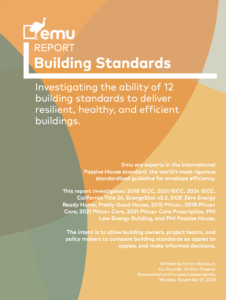
To truly understand the Passive Building value, it helps to look at the data. Emu Passive has published a thorough, independent study comparing Passive House Standards to regular building Code, as well as to other popular green building standards.
This study breaks down the exact differences in energy usage, carbon emissions, and expected thermal comfort across different compliance pathways. If you are a builder, architect, or homeowner trying to decide which standard to pursue, this data is invaluable. The complete study is available for free download on our website, providing clear insights into why the envelope-first approach consistently outperforms the alternatives.
Global Adaptability: From Subarctic to Tropics
Contrary to a popular misconception, Passive House Standards are not just for cold climates in Central Europe. The physics of building science apply everywhere. The standards have been successfully implemented in a incredibly wide range of climate conditions around the globe, from the subarctic temperatures of Alaska to the hot, humid environments of Dubai. The energy model simply adapts the required insulation levels and window specifications to manage the specific challenges of the local climate, whether that means keeping the bitter cold out or rejecting intense solar heat gain.
Furthermore, Passive Buildings are not just single-family houses. The core Passive Building principles apply to any enclosed structure. Successful certified projects include large office buildings, public schools, supermarkets, museums, factories, and massive sports facilities.
Along the same line, these principles can be applied to retrofit projects. The Passive House Institute offers a specific standard called EnerPHit for retrofits, acknowledging that existing buildings pose unique challenges. Applying these principles to retrofits is one of the most effective ways to upgrade our aging, inefficient building stock to meet modern performance and comfort demands.
Construction Quality and Hands-On Training
Designing a high-performance building on paper is only half the battle. A key step in actually meeting the stringent Passive House building performance metrics is the construction quality in the field. Meticulous execution of airtightness taping, proper installation of high-performance windows, and exact execution of thermal bridge-free details are required to pass the final certification testing.
This critical need for field execution is what brought Emu to develop the integrated Passive Design/Buildâ„¢ curriculum. We focus extensively on hands-on training for builders, architects, and other construction professionals. By bridging the gap between theoretical building science and practical job-site execution, we empower construction teams to deliver the ultimate Passive House value to their clients without the guesswork.
Takeaways - Passive House Standards
What are the main Passive House Standards?
Passive House Standards are rigorous, performance-based energy efficiency building standards that focus on an envelope-first approach to drastically reduce the heating and cooling demand of a building. The International Passive House Institute (PHI) defines the global benchmark for these standards.
What is the envelope-first approach in building?
The envelope-first approach focuses on optimizing the building’s outer shell – walls, roof, and windows – through superinsulation and airtightness to prevent energy loss. This reduces the need for large heating and cooling systems, offering a more durable and efficient solution than offsetting energy loss with solar panels.
What are the five key Passive House principles?
The five core Passive House principles are: 1) Superinsulation, 2) Thermal bridge-free design, 3) High-performance fenestration (windows and doors), 4) Airtightness, and 5) Fresh air ventilation with heat recovery.
What is the difference between PHI and Phius?
PHI (Passive House Institute) is the international organization that sets the global standard for Passive House construction. Phius is a United States-based organization offering similar standards, though the average performance of a Phius building typically aligns closer to a PHI Low Energy Building rather than a fully certified PHI Passive House.
What is passive survivability?
Passive survivability, or thermal resilience, is a building’s ability to maintain safe and habitable indoor temperatures during an extended power outage or extreme weather event. Passive buildings excel at this due to their highly insulated and airtight envelopes.
Can Passive Building Standards be applied to existing buildings?
Yes. Passive Building principles can be applied to retrofits. The Passive House Institute offers the EnerPHit standard specifically designed to guide the deep energy retrofitting of existing buildings.