
Passive House, Warm, Hot, and Humid Climates, and Multi-Family Study.
 by Enrico Bonilauri - July 2, 2026
 No comments
Passive House strategies are gaining ground across the United States, though adoption remains slower in warm, hot, and humid regions. A significant factor is the persistent misconception that Passive House does not perform well in high-temperature or high-humidity conditions.
The evidence does not support that claim. Passive House delivers measurable value in these climates, including improved indoor air quality, thermal comfort, and thermal resilience. To evaluate this systematically, we conducted a multifamily simulation study across ten US locations. The findings are clear and instructive.
Why Passive House Matters in Warm Climates
Thermal resilience deserves attention before we examine the data. It is not an optional performance metric. It has direct consequences for occupant safety.
The 2021 Texas Power Crisis illustrates the stakes. Widespread power outages left thousands of homes uninhabitable within hours. When grid supply failed, buildings with poor insulation and significant air leakage could not maintain safe indoor temperatures. This is not a problem exclusive to older construction. New buildings built to standard code face the same vulnerability.

Passive House addresses this directly. A well-designed high-performance building maintains stable interior conditions for considerably longer during power outages, functioning much like a thermally insulated container – like your Yeti cooler. That characteristic becomes critical during heat events and extended grid disruptions. This is a core dimension of Passive House that often goes underappreciated in hot and humid climates.
There is also a widespread belief that the international Passive House standard is incompatible with hot and humid conditions. Documented projects contradict this. The Dubai Passive House office building, among others, has been constructed and monitored in conditions far more extreme than most of the American South. Passive Buildings have a proven track record internationally in warm, hot, or humid climates, and that record is directly applicable to US climate zones.
How We Built this Study
To assess performance with precision rather than assumption, we developed a structured study focused on Passive House optimization for an all-electric multi-family project.
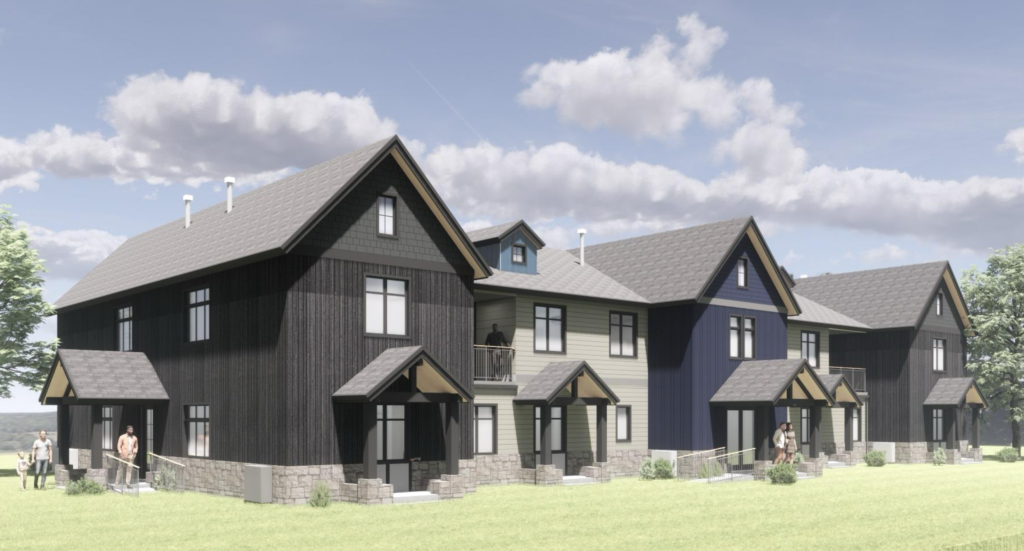
We used a 14-unit multifamily building as the reference. Performance was measured as combined site energy demand for heating and cooling. The building was assumed to be all-electric, serviced by air-source heat pumps for both heating and cooling.
We evaluated seven Passive House strategies:
- Thermal insulation
- Thermal mass
- Ground coupling
- Air tightness
- High-performance windows
- Solar control
- Heat recovery ventilation
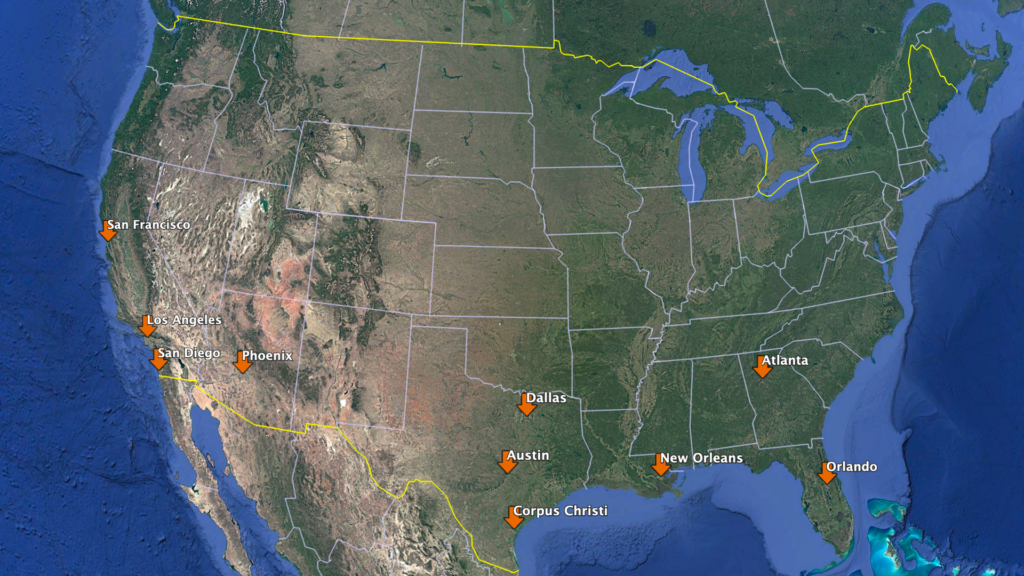
All simulations were conducted using the Passive House Planning Package (PHPP). We modeled the building across 10 US locations: Los Angeles, San Diego, San Francisco, Phoenix, Atlanta, Dallas, Austin, Orlando, New Orleans, and Corpus Christi. This selection spans a representative range of conditions, from warm and dry to very hot and very humid.
The performance baseline used the 2024 IECC prescriptive requirements, including R-values, window U-factors, and air leakage limits.
One methodological decision defines the study’s scope. We did not model code-minimum ventilation, which we consider insufficient to deliver acceptable indoor air quality. Every scenario, including the baseline, included a continuous fresh air ventilation system. Fresh air rates were determined based on occupancy and CO2 estimation per EN 779. All results therefore reflect buildings designed to support occupant health.
The Strategies We Tested
Each strategy was evaluated starting from the 2024 IECC baseline, with performance improvements applied in incremental steps.
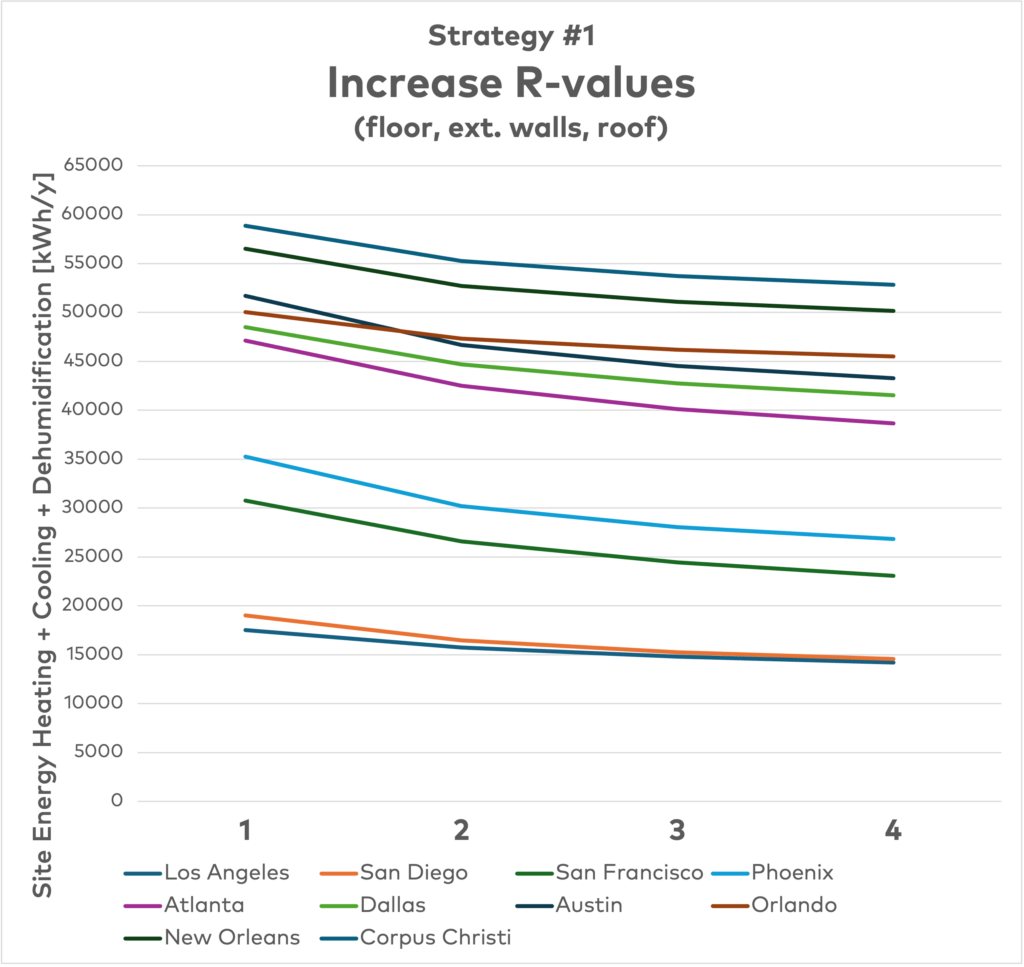
Thermal insulation. Starting from the prescriptive 2024 IECC R-values, insulation was added in three increments: R10, R20, and R30.
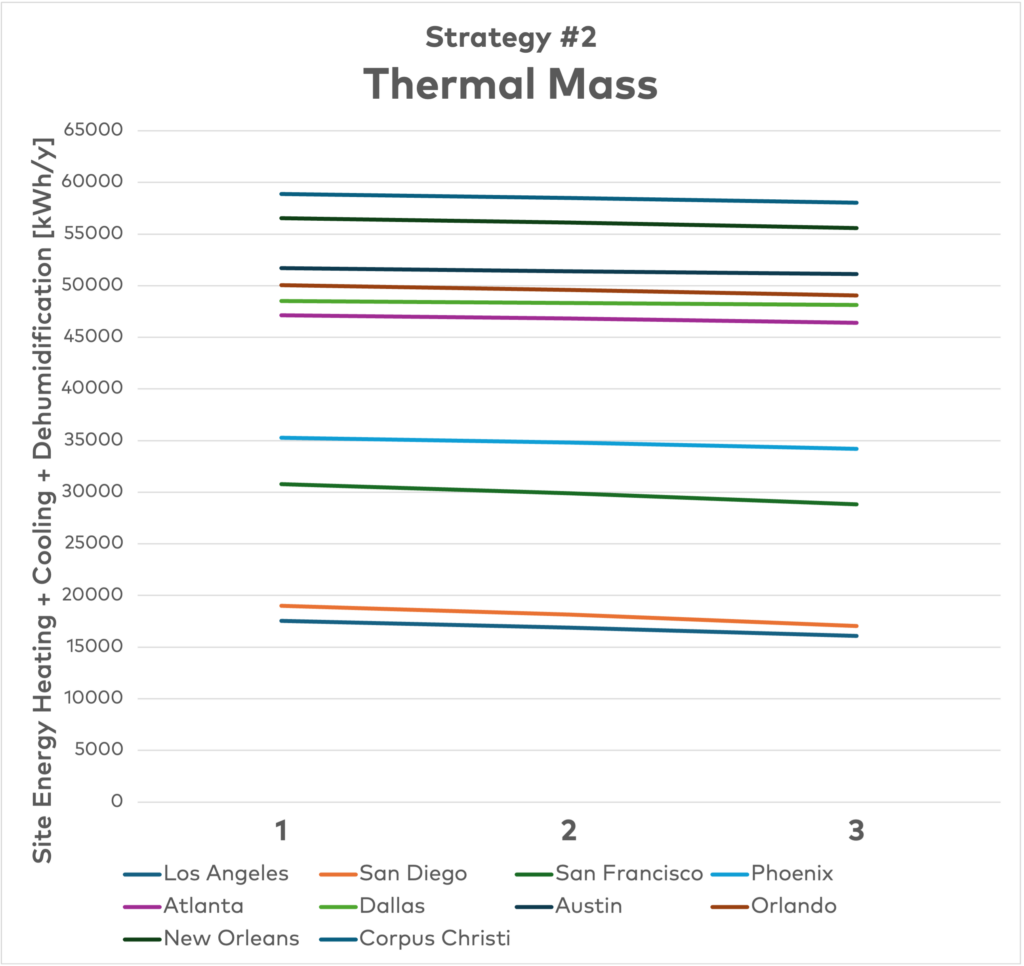
Thermal mass. The baseline used lightweight stick-frame construction. A slab-on-grade configuration was introduced as an intermediate step, followed by a high thermal mass scenario with significant mass added to all interior walls. This allowed direct measurement of thermal mass effectiveness in warm climates.
Ground coupling. Starting from code-minimum under-slab insulation, R-values were increased incrementally to evaluate whether additional sub-slab insulation is effective in hot and humid regions.
Air tightness. Starting at the 2024 IECC air leakage threshold, the envelope was made progressively tighter across successive steps.
High-performance windows. Code-minimum window and door specifications served as the baseline, with glazing and frame performance improved incrementally. The reference building has a straightforward design with a limited glazing-to-floor-area ratio.
Solar control. Combinations of adjustable shading configurations (none, interior, and exterior) and glass coatings were tested. The objective was to identify the most effective balance between summer solar gain control, winter passive solar contribution, and daylight availability.
Heat recovery ventilation. The baseline assumed continuous fresh air supply with no heat or moisture recovery. Sensible and latent heat recovery were added in incremental steps. Latent recovery is central to ERV moisture control in hot climates.
What We Found
The simulation results provide a clear ranking of strategy effectiveness and offer useful guidance for multi-family Passive Building optimization in warm, hot, and humid conditions.
ERV Ventilation Ranked First
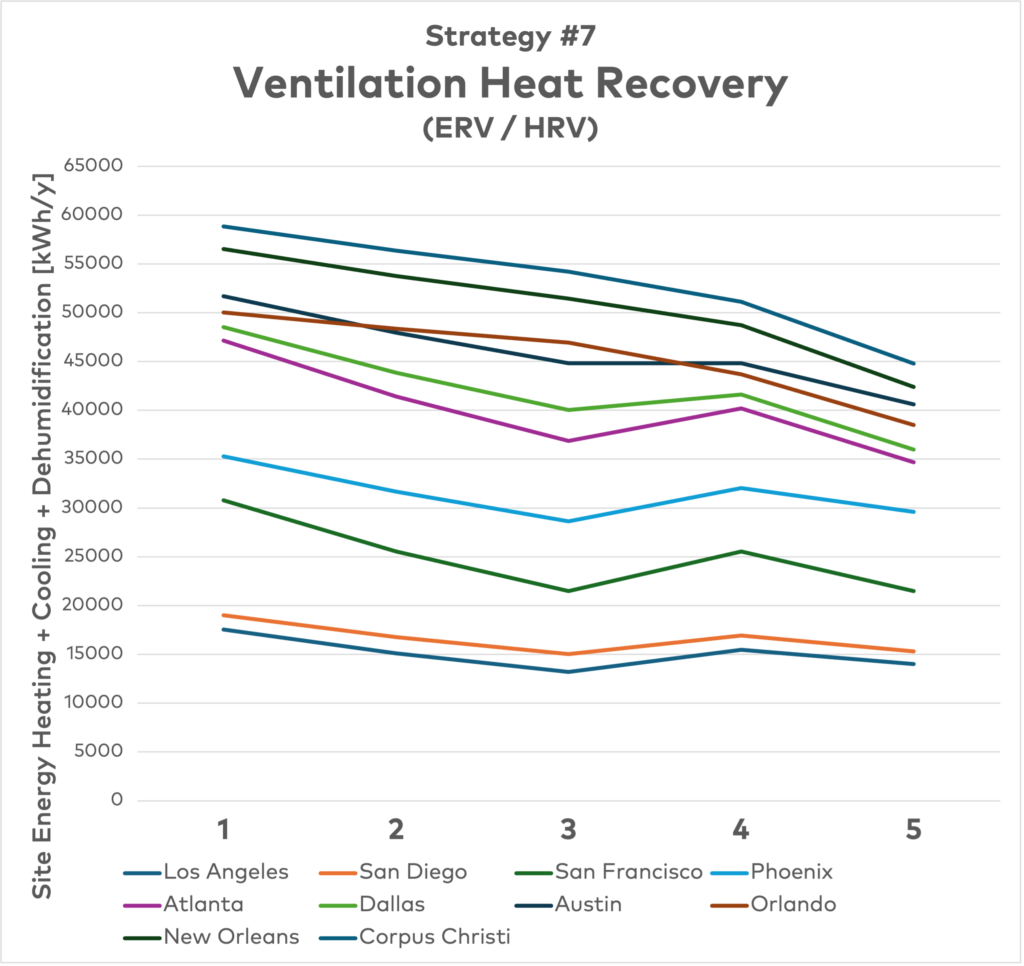
Heat recovery ventilation was the single most impactful strategy across the study. Because all scenarios required continuous fresh air exchange, the method of conditioning that incoming air proved decisive.
In warm, hot, and humid climates, an enthalpic recovery ventilator — an ERV, sometimes called energy recovery ventilator — reduced combined site energy demand for heating and cooling more than any other measure. The advantage increased in proportion to ambient humidity levels. An ERV recovers both sensible heat and latent heat (moisture), which directly reduces dehumidification demand. Effective Passive House moisture control depends substantially on this capability.
Air Sealing Ranked Second
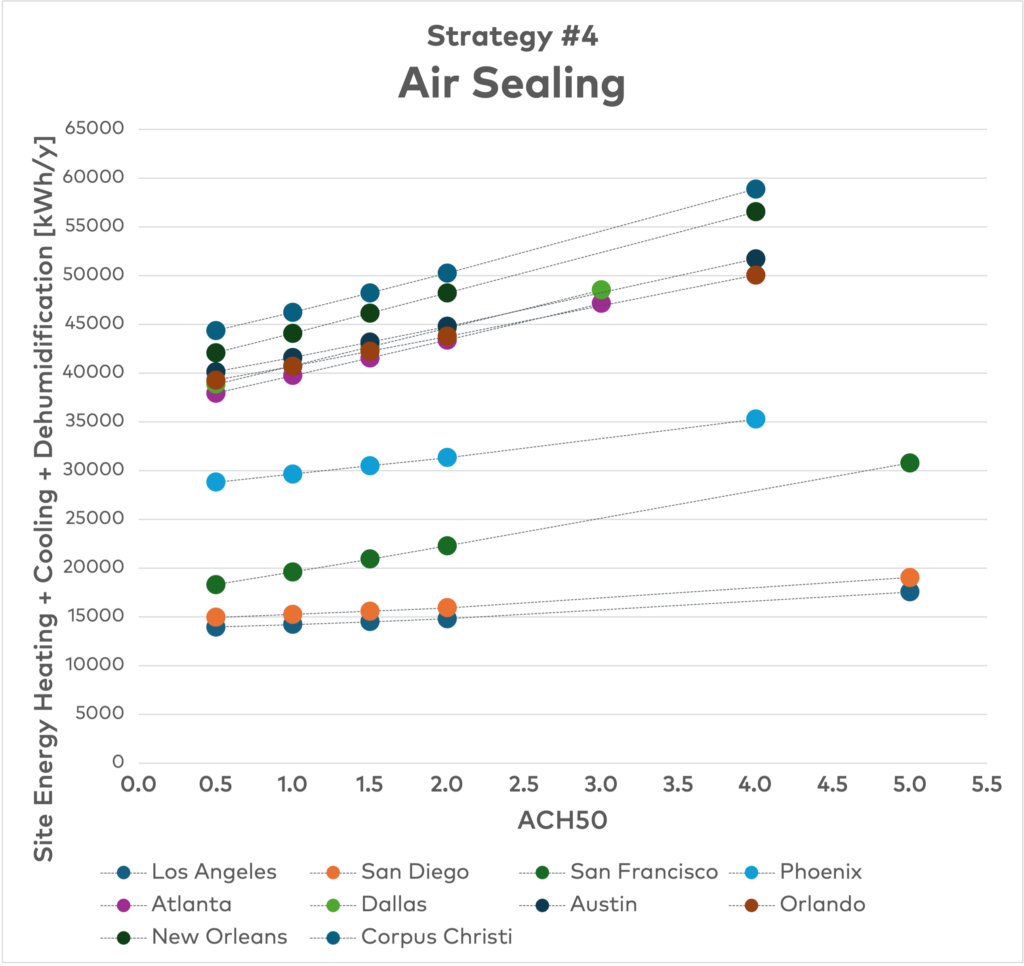
Envelope airtightness was the second most effective strategy. A well-sealed building envelope prevents uncontrolled infiltration, which is especially consequential when outdoor air carries a high moisture load. Controlled air exchange reduces latent loads and improves the predictability of mechanical system performance.
Thermal Insulation Ranked Third
Additional insulation ranked third overall. While it consistently reduced energy demand, the gains diminished with each successive increment — particularly in the hottest and most humid locations. Insulation improves envelope performance but does not address latent loads directly.
Thermal Mass Ranked Last
Thermal mass produced the least measurable impact of the seven strategies tested. Thermal mass effectiveness in hot climates was consistently low across all climate zones evaluated. Despite its established role in traditional passive design guidance for warm regions, thermal mass did not compete with ERV ventilation or air sealing in terms of measured energy performance.
Lessons Learned
The study produces several findings with direct implications for design and construction practice in warm, hot, and humid US climates.
Passive House strategies produce measurable results in these climates. They reduce combined site energy demand for heating and cooling, supporting both Net Zero and building electrification goals. They also increase thermal resilience — a property that proved critical during the 2021 Texas Power Crisis and will remain relevant as grid reliability continues to be tested.
Conventional passive design rules require reconsideration. Thermal mass is one of the most frequently cited strategies for warm-climate buildings, yet our data shows it delivers significantly less benefit than other Passive House measures. This is also consistent with the study “Passive House in South West Europe” published by the Passive House Institute. Intuition-based design approaches do not substitute for quantitative analysis.
In humid climates, latent load is the primary challenge. As humidity increases, moisture management becomes more important than temperature management. Most Passive House strategies — including additional insulation, thermal mass, high-performance windows, shading, and thermal bridge mitigation — have limited effect on latent loads. Air sealing and ERV ventilation are the two measures that directly address moisture. In combination, a well-sealed envelope with an ERV consistently outperformed all other strategies in this study.
For practitioners working in the American South, Southeast, and Southwest, the priority hierarchy is clear: focus first on a verified, continuous air barrier and a properly sized ERV with enthalpy recovery. These two measures will have greater impact on energy performance, occupant comfort, and building resilience than any other combination of passive strategies.
Are you interested in learning more on this topic? Review our webinars and free presentations.
FAQ: Passive House in Warm, Hot, and Humid Climates
Does Passive House work in hot and humid climates?
Yes. The international Passive House standard in hot and humid climates delivers measurable improvements in indoor air quality, thermal comfort, and thermal resilience. Documented projects — including the Dubai Passive House office building — confirm the standard performs well under conditions of high heat and humidity.
What is the most effective Passive House strategy in hot and humid climates?
Heat recovery ventilation ranked first. An enthalpic ERV recovers both sensible and latent heat, reducing cooling loads and dehumidification demand. ERV moisture control in hot climates proved to be the highest-impact measure in multifamily applications.
How effective is thermal mass in warm and hot climates?
Thermal mass effectiveness in warm climates and hot climates was low. In our study of a 14-unit multifamily building across 10 US locations, thermal mass ranked last among the seven strategies tested, despite its common association with passive design in warm climates.
What matters most for Passive House moisture control?
Air sealing and ERV ventilation are the only two strategies that significantly reduce latent (moisture) loads. Additional insulation, thermal mass, high-performance windows, shading, and thermal bridge avoidance have minimal impact on moisture.
Why does Passive House improve thermal resilience?
A Passive House maintains stable interior temperatures substantially longer during power outages due to its highly insulated, airtight envelope. During events such as the 2021 Texas Power Crisis, buildings with standard insulation and air leakage became uninhabitable rapidly, while high-performance envelopes retained safe conditions significantly longer.
How was this multifamily study conducted?
Emu Passive simulated a 14-unit reference building using PHPP across 10 US locations. Performance was measured as combined site energy demand for heating and cooling, using an all-electric configuration with air-source heat pumps and continuous fresh air ventilation included in every scenario.
Comments are closed.