
2025 NYCECC: Why Passive House is Your Cheat Code
 by Enrico Bonilauri - March 15, 2026
 No comments
If you work in the New York City AEC industry, you have likely felt the ground shifting beneath your feet. On March 30, 2026, the 2025 New York City Energy Conservation Code (NYCECC) officially becomes the law of the land.
The “good enough” era of building envelopes is officially over. We can no longer build a massive multi-family complex, cross our fingers, and hope the building passes its final inspections. The new code demands a level of precision that developers previously reserved for high-performance niche projects.
But here is the secret for commercial and multi-family architects and builders: If you already design to Passive House standards, you are not just meeting the new code. You have already crushed it.
By utilizing Passive House principles, you build a compliance insurance policy. You secure better indoor air quality, lower operational bills, and a stress-free path to a Certificate of Occupancy. Let us explore exactly how Passive House standards help you master the strictest new code requirements.
No More “Hail Mary” Testing
The 2025 code completely transforms how builders handle building envelope testing. It introduces a rigorous, staged testing protocol. Instead of one stressful test at the very end of construction, the city now requires a multi-stage inspection process documented via updated TR8 reports.
You must prove the continuity of your air barrier while the walls are still open. This massive shift makes NYCECC air tightness a primary focus from day one of construction. You cannot wait until the drywall is up to find out your building leaks air.
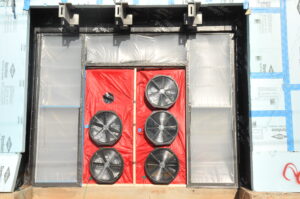
The code explicitly targets stringent metrics. You must hit 0.40 CFM/ft ² at 75 Pascals. Verifying this requires preliminary, mid-construction, and final inspections. Mastering the NYC energy code air tightness requirements means training your entire crew to respect the air barrier at every single phase of construction. Learn more about training options in New York City.
The Passive House Advantage for Air Sealing
This is where the Passive House approach acts as your ultimate cheat code. Passive House targets are roughly three to five times stricter than the baseline code, often aiming for roughly 0.035 CFM/ft ².
When you aim for Passive House certification, you focus heavily on a metric known as Air Changes per Hour (ACH). While builders scramble to figure out the new NYECC ACH standards, Passive House designers already target a remarkably tight 0.6 ACH50. You do not have to worry about meeting the baseline NYC energy code ACH when your design dictates a practically airtight vault.
In the Passive House world, staged testing is never a regulatory hurdle. It is a standard, expected quality-control tool. Because you verify your air barrier continuously, passing the mandatory NYECC blower door test becomes a non-event. By the time the city inspector shows up to conduct the final NYC energy code blower door evaluation, you already know your building will pass with flying colors.
Hunting Down “Energy Vampires”
Section C402.7 of the new energy code introduces another massive paradigm shift for New York City developers. It forces architects and engineers to stop pretending that insulation acts as a magic, unbroken blanket.
You now have to account for every single balcony slab, shelf angle, and window-to-wall transition that leaks heat. The city wants to stop these “energy vampires” from draining efficiency out of large commercial and multi-family buildings.
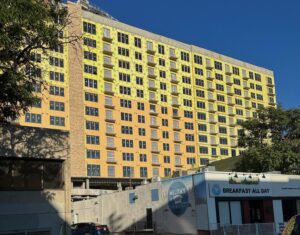
Addressing NYECC thermal bridging requires meticulous detailing. You must provide specific mitigation strategies for every structural penetration that breaks the thermal envelope. The city requires you to calculate an accurate NYECC effective R-value that reflects how the wall actually performs in the real world, rather than what the insulation manufacturer prints on the package.
Solving the Math Before Construction Starts
Accounting for every steel beam and concrete slab that penetrates your insulation is mathematically exhausting. You must prove your NYC energy code effective R-value meets the strict new minimums, even after accounting for structural steel and fasteners.
Fortunately, a core pillar of Passive House methodology is the Hygiene Requirement. With the thorough thermal bridge avoidance and mitigation of Passive House, project teams can easily meet the 2025 NYCECC effective R-value requirements, and mitigate the risk for mold and condensation. This also helps addressing some of the most overlooked causes of thermal bridging in American high-performance construction projects.
Passive House designers completely design out NYC energy code thermal bridging issues during the schematic phase. You solve the complex math long before the first brick is laid. When the city asks for your documentation, you hand them a fully optimized, thermal-bridge-free assembly that vastly outperforms their baseline requirements.
How They Stack Up: NYCECC vs. Passive House
To truly understand why Passive House is the ultimate compliance strategy for multi-family and commercial builds, we must look at the data side by side.
When you compare the baseline requirements of the 2025 code to the established standards of Passive House, the contrast is stark.
- Air Leakage: The 2025 NYCECC requires 0.40 CFM/ft ² via mandatory staged testing. Passive House sets the gold standard at approximately 0.035 CFM/ft ² (i.e. PHI Passive House), or 0.06 CFM/ft ² (Phius).
- Thermal Bridges: The 2025 NYCECC asks you to mitigate and document your structural penetrations. Passive House requires you to eliminate them entirely by design.
- Inspections: The 2025 NYCECC relies on staged TR8 inspections by city officials. Passive House utilizes rigorous third-party verification throughout the entire build process.
- Compliance Risk: Trying to barely pass the 2025 NYCECC carries moderate to high risk, especially if your teams are new to staged testing. Utilizing Passive House carries very low risk, making the baseline code look like the “easy” version.
Design for the Ceiling, Not the Floor
The 2025 NYCECC is essentially pushing the entire New York City construction industry toward Passive House principles. Trying to barely pass the new code is a risky, expensive gamble. If your multi-family building fails its final blower door test, the cost of ripping open walls to find the leak will destroy your project budget.
When you adopt Passive House standards, you protect your investment. You ensure your commercial projects deliver exceptional comfort and predictable energy costs. Most importantly, you remove the stress and uncertainty from the final inspection process.
Do not wait until 2026 to figure out your compliance strategy. Start designing for the ceiling of building performance, rather than scraping the floor of code minimums. If you want to see how your current multi-family or commercial project stacks up against the new requirements, the team at Emu Passive can help you break down the specific TR8 inspection milestones you will need to hit.
2025 NYECC FAQ
What is the NYCECC air tightness requirement for 2025?
The 2025 code mandates strict air leakage limits for commercial and multi-family buildings. Specifically, NYC energy code air tightness rules require buildings to achieve 0.40 CFM/ft ² at 75 Pascals, verified through staged testing while walls are still open.
How does a NYECC blower door test work under the new code?
Unlike older codes, the new NYECC blower door test requires staged verification. You cannot wait until construction ends. A NYC energy code blower door evaluation happens in phases (preliminary, mid-construction, final) to ensure the air barrier remains continuous.
What are the NYECC ACH targets?
While the exact NYECC ACH (Air Changes per Hour) depends on the building volume and geometry, the focus is heavily on reducing leakage. Passive House standards vastly exceed any baseline NYC energy code ACH by targeting a rigorous 0.6 ACH50.
How does the new code address NYECC thermal bridging?
Section C402.7 strictly regulates NYECC thermal bridging. Designers must document and mitigate heat loss from balcony slabs, shelf angles, and window transitions. Mastering NYC energy code thermal bridging requires detailed modeling to prevent energy vampires.
What is a NYECC effective R-value?
A NYECC effective R-value is the actual insulating performance of a wall assembly after accounting for structural penetrations like steel framing and fasteners. The NYC energy code effective R-value stops designers from claiming the printed R-value of insulation without factoring in the heat lost through thermal bridges.
Comments are closed.