
Wildfire Smoke Filter Isn’t Enough: How to Really Protect Indoor Air
 by Enrico Bonilauri - July 22, 2026
 No comments
Wildfire smoke is back in the headlines, and it’s not going away. Smoke drifting down from Canadian wildfires has blanketed New York City, New Jersey, Boston, and much of the East Coast, affecting millions of people. Out West, builders in California, Colorado, and neighboring states already know this story by heart.
Here’s the hard truth: this isn’t a freak event anymore. It happened just a few years ago, and it will keep repeating. For builders and general contractors, that means indoor air quality is no longer a nice-to-have—it’s a core part of delivering safe, high-performing buildings.
In this guide, you’ll learn:
- Why wildfire smoke and PM2.5 are serious health risks
- Why a wildfire smoke filter alone won’t fully protect occupants
- How MERV and HEPA filters compare across building codes
- Why an airtight building envelope is the missing half of the solution
Let’s dig into the building science that actually works.
Why Wildfire Smoke Is a Recurring Health Crisis
Wildfire smoke carries fine particulate matter known as PM2.5—particles so small they slip deep into your lungs and bloodstream. Prolonged exposure is linked to respiratory disease, heart problems, and even cancer. This is exactly why occupants notice headaches, irritated eyes, and breathing trouble on smoky days.
The frustrating part? Smoke doesn’t stay outside. In a typical building, it seeps through gaps, cracks, and leaky ductwork, filling rooms that should feel safe. Once it’s inside, occupants breathe it whether the windows are open or not.
That’s the problem builders have to solve—and the good news is that proven building science already gives us the answer.
The Corsi-Rosenthal Box: A Helpful but Partial Fix
Many people build a Corsi-Rosenthal box—a simple DIY setup pairing a box fan with several MERV filters—to clean the air during smoke events. It’s a smart, affordable idea, and it does capture some airborne pollution.
But let’s be clear about its limits. A Corsi-Rosenthal box only cleans smoke that has already entered the building. It doesn’t stop pollution at the source, and it doesn’t protect occupants from being exposed in the first place. It’s a bandage, not a cure.
The real solution combines two powerful strategies:
- A continuous supply of filtered, balanced fresh air through an ERV or HRV system
- An airtight building envelope that keeps smoke out to begin with
Together, these create genuine control over the air inside your building.
Why an ERV/HRV System Beats a Standalone Filter
An energy recovery ventilator (ERV) or heat recovery ventilator (HRV) delivers fresh, filtered air while recovering energy from the air it exhausts. Compared to a standalone indoor air filter, it dramatically improves indoor air quality for three reasons:
- It filters at the point of entry. Pollutants get captured before they reach occupants—not after.
- It handles more than smoke. A good building air filter catches wildfire smoke, everyday city pollution, and seasonal pollen alike.
- It supplies genuine fresh air. This dilutes hazards a filter can’t touch, like carbon dioxide, carbon monoxide, and VOCs.
A Corsi-Rosenthal box can’t do any of that. The ERV/HRV approach turns your ventilation system into a controlled, filtered gateway for clean air.
MERV Filter Grades by Building Code and Standard
Not all filters perform equally, and building codes reflect that with wildly different requirements. The reference standard for MERV ratings is ASHRAE 52.2. Here’s how common US codes and standards stack up for their required building air filter or HVAC air filter grade.
|
Building Code / Standard |
Minimum Filtration Requirement |
Particulate Matter PM 2.5 Filtration |
|---|---|---|
|
“Regular Building Code” (IBC / IMC / IRC / IECC, 2024 and earlier editions) |
No hard air filtration requirement |
N/A |
|
ENERGY STAR |
MERV 6 |
– |
|
DOE Zero Energy Ready Home |
MERV 8 |
20% |
|
Phius |
MERV 8 |
20% |
|
California Title 24 |
MERV 13 |
85% |
|
PHI Passive House (International) |
MERV 13 |
85% |
A few takeaways worth noting:
- Even the latest international building codes (2024 IBC, IMC, IRC, and IECC) set zero hard requirements for air filtration.
- “High-performance” programs like ENERGY STAR and DOE Zero Energy Ready Home require only MERV 6 and MERV 8, respectively.
- Phius requires just MERV 8—less strict than California Title 24—meaning occupants can still be exposed to significant airborne pollution inside a Phius building.
- California Title 24 and PHI Passive House demand the strongest filtration at MERV 13.
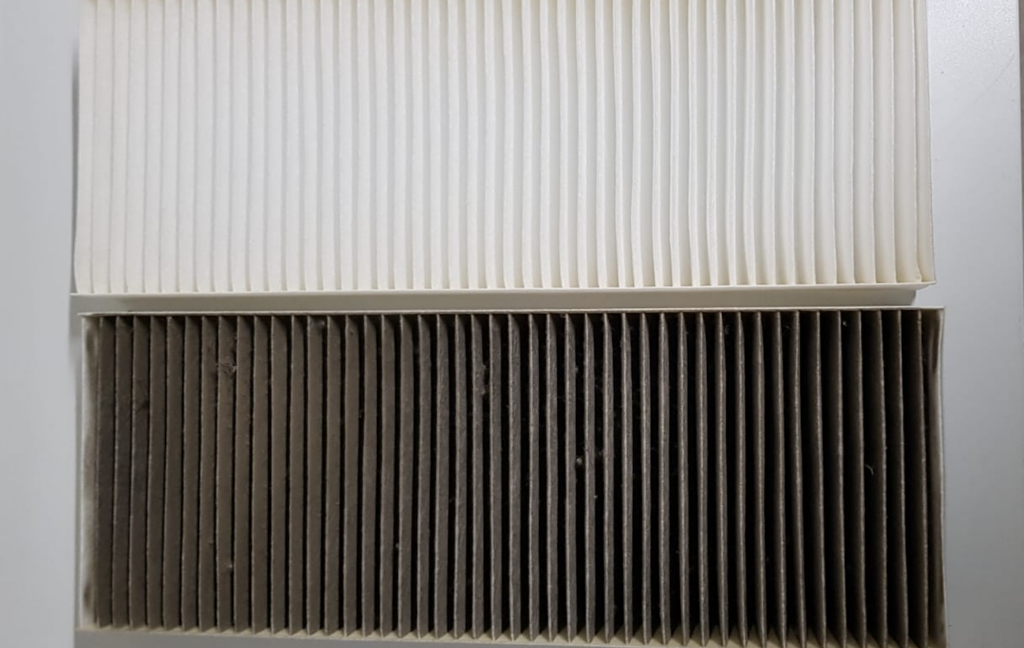
Takeaway: If protecting occupants from wildfire smoke matters to you, a MERV 13 building air filter should be your baseline—regardless of what the minimum code allows.
Are MERV 13 Filters the Ultimate Wildfire Smoke Filter?
Not quite. MERV 13 is excellent, but it only captures part of the solid component of wildfire smoke. The particle-size distribution in vegetation smoke includes ultra-fine particles that slip past even a strong indoor air filter.
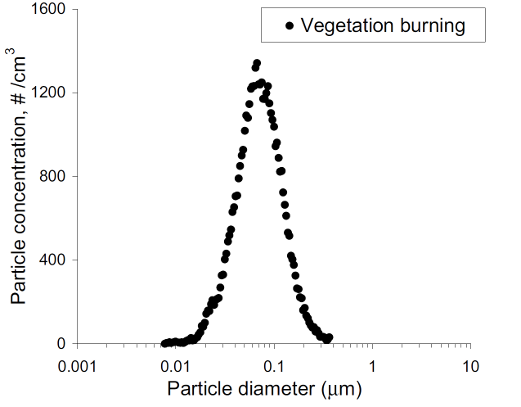
To capture more, you’d step up to a HEPA filter, which traps far more of that fine wildfire smoke. But HEPA comes with a trade-off: these filters are so dense that ventilation fans must push much harder to move air through them. That means higher energy use and potentially more noise.
Here’s our practical recommendation:
- Install MERV 13 as the default fire smoke filter for everyday operation.
- Add a HEPA filter in a dedicated filter box for emergency use during heavy wildfire smoke events.
This gives you efficient day-to-day performance with a serious backup when the air outside turns dangerous.
The Second Pillar: An Airtight Building Envelope
Filters are only half the equation. The other half—and the one too many projects ignore—is an airtight building envelope.
In an airtight building, a continuous, designated air barrier keeps smoke out. The tighter the envelope, the fewer chances smoke has to sneak inside through cracks, joints, and penetrations. When you seal the building well, the only entry point for outside air becomes your ERV/HRV system, where you’ve already placed the right filter.
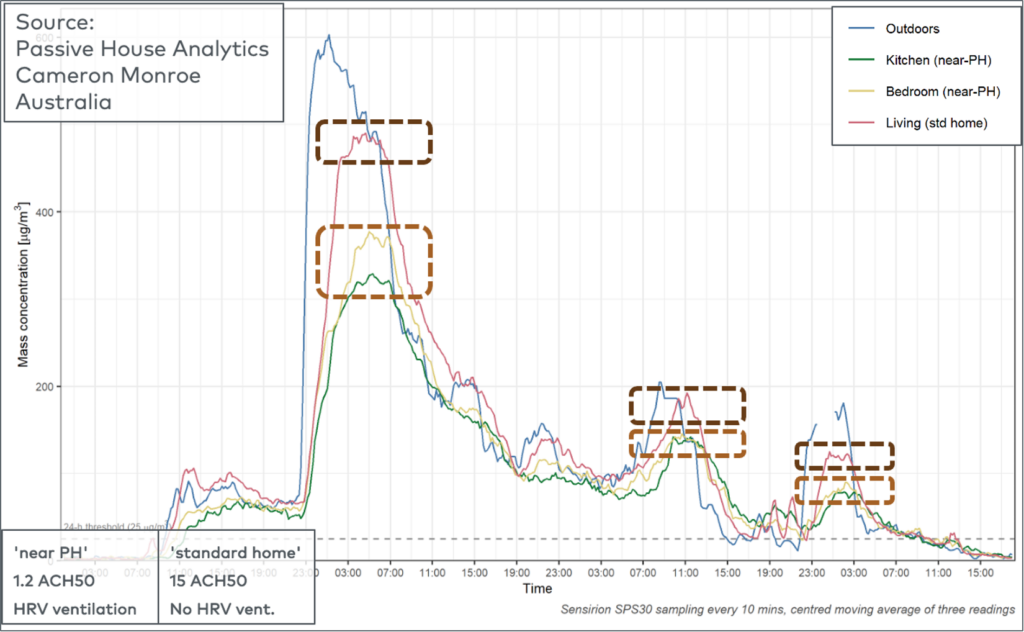
This isn’t just theory. In Melbourne, Australia, Cameron Monroe monitored PM2.5 concentrations inside a Passive House retrofit and compared them to a conventional building. The airtight, filtered building maintained dramatically cleaner indoor air during outdoor pollution spikes. Real buildings, real data, real protection.
Air Sealing Requirements by Standard
Codes measure airtightness differently—some use air changes per hour (ACH50), others use surface-specific leakage (q50). Here’s how key standards compare.
|
Standard |
Air Sealing Requirement |
|---|---|
|
California Title 24 |
Compartmentalized testing for attached multifamily units only; no requirement for commercial buildings or single family homes |
|
2025 NYCECC |
Blower door testing now required on all commercial buildings (target still modest) |
|
Phius (single-family) |
~1.1 ACH50 |
|
PHI Passive House |
0.6 ACH50 |
Key insights for builders:
- California Title 24 only regulates attached multifamily units and has zero requirements for commercial buildings—limiting its effectiveness against wildfire smoke.
- The 2025 NYCECC now requires blower door testing on all commercial buildings. The target is still low, but it’s a hugely important first step.
- Phius single-family homes can be nearly twice as leaky as PHI Passive House homes (1.1 vs 0.6 ACH50), which limits their ability to shield occupants from smoke, city pollution, and pollen. See Emu Report on Building Standards for more details.
Retrofits Need Clean Air Too
The same principles apply to existing buildings—and that’s important, because new construction is only a fraction of the total building stock. Retrofitting an older home or commercial building with improved air sealing and a balanced ERV or HRV system can significantly reduce smoke infiltration and clean up indoor air quality during wildfire events. A full gut renovation isn’t always required. Strategic air sealing at the most common infiltration points—around windows, doors, penetrations, and mechanical chases—combined with a properly filtered fresh air system, can move an existing building meaningfully closer to the protection that a tight, well-ventilated new build provides. Cameron Monroe’s monitoring data from a Passive House retrofit in Melbourne is proof: better envelope performance and controlled ventilation deliver cleaner indoor air, even in an existing building.
Air Quality Is an Everyday Problem—Not Just a Wildfire One
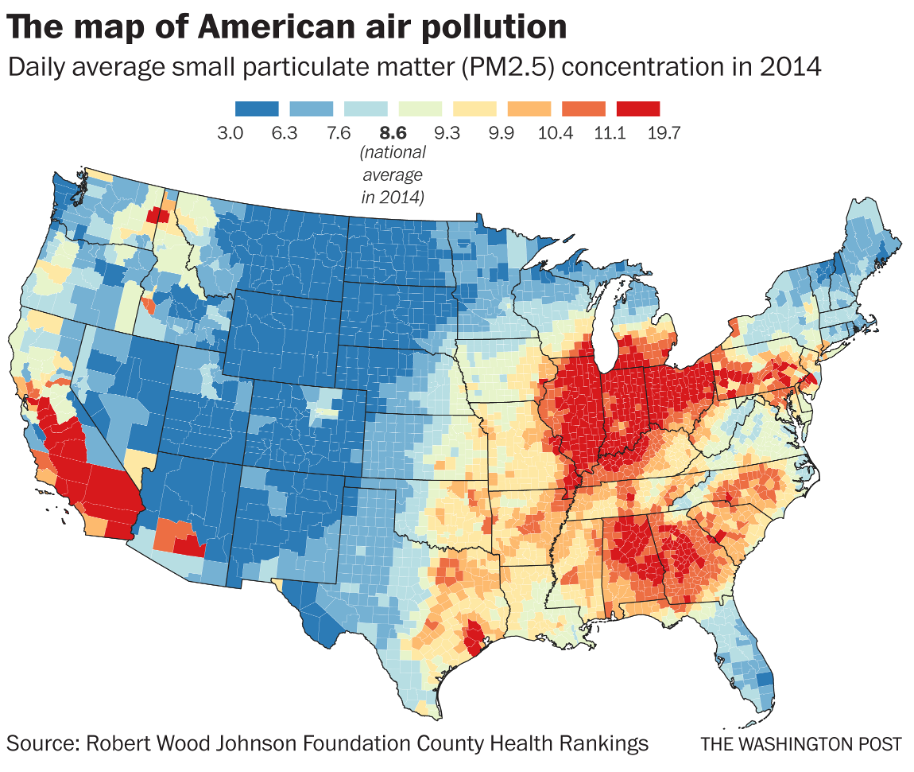
Wildfire smoke grabs the headlines, but PM2.5 exposure is a year-round problem for millions of Americans—no fire season required. Los Angeles and Southern California consistently rank among the worst in the nation for particulate pollution, driven by traffic, industrial activity, and temperature inversions that trap dirty air close to the ground. Title 24 fails to address this problem. The Midwest faces persistent pollution from manufacturing and freight corridors, while the Northeast Corridor—from Washington, DC to Boston—deals with dense urban emissions compounded by regional atmospheric conditions. For occupants in these areas, a leaky building with no real filtration isn’t just a wildfire risk; it’s a daily health hazard. That’s exactly why the combination of MERV 13 filtration, balanced ERV/HRV ventilation, and a tight building envelope matters every single day.
Why Airtightness Is About More Than Energy
Builders often think of air sealing purely as an energy-efficiency upgrade—and yes, an airtight building is more efficient. But the bigger win is control over indoor air quality. When your envelope is tight, you decide where air enters, and you place the right home air filter or house air filter exactly at that point.
That’s the whole philosophy: seal the building, then filter the one controlled point of entry. Combine that with fresh, balanced ventilation, and you’ve built a space that protects people during the worst air-quality events—not just a code-compliant box.
Conclusion: Build for Clean Air, Not Just Compliance
Wildfire smoke isn’t a rare emergency anymore—it’s a recurring reality your buildings need to handle. A standalone wildfire smoke filter helps, but real protection comes from combining a MERV 13 (plus emergency HEPA) filtration strategy with a genuinely airtight envelope and balanced ERV/HRV ventilation.
Meeting the minimum code won’t cut it. The builders who thrive will design for clean air on purpose, delivering healthier, more resilient, and more valuable buildings.
Ready to master the building science behind airtight, healthy homes? Explore Emu Passive’s hands-on Passive House and building science training, and learn how to protect occupants from wildfire smoke—one well-sealed, well-filtered building at a time.
Frequently Asked Questions
What is the best air filter for wildfire smoke?
For everyday protection, a MERV 13 filter is the recommended baseline—it captures a large share of the solid particles in wildfire smoke. During heavy smoke events, add a HEPA filter for maximum capture. Because HEPA filters are dense and demand more fan power, the smartest setup uses MERV 13 for regular operation and HEPA as an emergency add-on.
Does a Corsi-Rosenthal box protect against wildfire smoke?
A Corsi-Rosenthal box helps, but only partially. It cleans smoke that has already entered the building rather than stopping it at the source, and it doesn’t prevent occupant exposure. It’s a useful temporary tool, not a permanent solution. Real protection comes from combining filtered fresh air with an airtight building envelope.
What’s the difference between an ERV/HRV system and a standalone air filter?
A standalone indoor air filter only cleans air already inside the building. An ERV or HRV filters incoming air at the point of entry, supplies genuine fresh air, and addresses hazards a filter can’t—like carbon dioxide and VOCs. It gives you controlled, continuous ventilation instead of reactive cleanup.
What MERV rating do building codes require?
It varies widely. The 2024 international codes (IBC, IMC, IRC, IECC) have no hard filtration requirement. ENERGY STAR requires MERV 6, while DOE Zero Energy Ready Home and Phius require MERV 8. California Title 24 and the PHI Passive House standard require the strongest filtration at MERV 13.
Why does an airtight building envelope matter for indoor air quality?
An airtight envelope keeps smoke and pollutants from leaking in through cracks and joints. The tighter the building, the more you control where air enters—ideally only through your filtered ERV/HRV system. This turns your ventilation system into the single, controlled gateway for clean air.
How airtight should a building be to keep smoke out?
Tighter is better. PHI Passive House buildings target 0.6 ACH50, while typical Phius homes allow around 1.1 ACH50—nearly twice as leaky. The lower the air-change rate, the fewer chances smoke has to penetrate, which is why Passive House–level airtightness offers stronger protection during wildfire events. There are no countereffects to a building being more airtight.
Do commercial buildings have to test for airtightness?
It depends on location. California Title 24 has no airtightness requirement for commercial buildings, which limits its effectiveness against wildfire smoke. However, the 2025 NYCECC now requires blower door testing on all commercial buildings—a modest target, but an important first step toward healthier commercial spaces.
Is air sealing only about energy efficiency?
No. While an airtight building is more energy efficient, the bigger benefit is control over air movement. When the envelope is sealed, the one point of entry for outside air becomes the fresh air system, where you can install the right building air filter or HVAC air filter to protect occupants from smoke and pollution.
Comments are closed.