
Insulation Thermal Capacity: A Better Metric for Thermal Insulation in Summer
 by Enrico Bonilauri - July 25, 2026
 No comments
Thermal capacity is the ability of an material to delay and reduce a heat wave as it moves through a building assembly. It works alongside thermal resistance, and it measures a complementary property. R-value quantifies how much an assembly resists steady-state heat flow. Thermal capacity describes how much energy the material absorbs in order to raise its temperature.
Under a summer heat wave, exterior surface temperatures rise sharply during the day and fall at night. The direction and intensity of heat flow change over each 24-hour cycle. The thermal capacity of a building assembly captures how an assembly responds to these swinging conditions—specifically, how long it takes for peak heat to travel through, and how much of that heat is reduced along the way.
What you’ll learn:
- The difference between thermal mass and thermal capacity
- How insulation thermal capacity delays and attenuates heat waves
- Which materials deliver the highest thermal capacity
- How to apply this in new construction and retrofits in warm and hot climates
How Insulation Thermal Capacity Affects Summer Heat Performance
During a summer heat wave, exterior surface temperatures swing sharply between day and night, creating cyclical heat flow conditions across the building envelope. Under these dynamic conditions, the timing and intensity of heat transfer through an assembly depend on more than steady-state resistance alone.
During a heat wave, two dynamic properties determine how an assembly performs:
- Delay (time lag): how many hours it takes for peak exterior heat to reach the interior surface
- Attenuation (decrement factor): how much the peak heat is reduced as it passes through the assembly
These properties are calculated using ISO 13786, the international standard for the dynamic thermal characteristics of building components. ISO 13786 models heat transfer under cyclical temperature conditions rather than static ones. The result is a realistic picture of how an assembly responds to daily temperature swings (e.g. on hot Summer days).
The variable that determines delay and attenuation is insulation thermal capacity—the product of a material’s specific heat, density, and thickness. Two assemblies sharing an identical R-value can produce very different results in summer conditions because thermal capacity is an separate property. Higher thermal capacity means more delay and greater attenuation.
Insulation Thermal Capacity vs. Thermal Mass
Thermal mass and thermal capacity are related concepts, but they operate in different locations within a building.
Thermal mass refers to dense interior materials—exposed concrete slabs, interior brick—positioned inside the conditioned space. These materials absorb heat that is already inside the building and release it later. In practice, the impact of thermal mass on the building Summer performance is limited. Emu Passive’s multifamily optimization study for hot and humid climates ranked thermal mass among the least effective envelope strategies compared to ERV ventilation, air sealing, and superinsulation. As a heat protection strategy, exposed interior thermal mass underperforms relative to the space and cost it requires.
Thermal capacity of a building assembly refers to the ability of a building material to impact the dynamic heat transfer through the assembly before it gets inside the building, by delaying the heat wave and reducing its intensity.
You can also add mass to a wall assembly using brick or concrete to increase its thermal capacity. This works thermodynamically, but it is impractical for three reasons:
- High embodied carbon: common concrete and brick carry a significant carbon footprint
- Low R-value: these materials add mass but minimal thermal resistance
- Required thickness: meaningful mass requires roughly 4–5 inches of brick or 6–8 inches of concrete, which most assemblies cannot accommodate
High thermal capacity insulation achieves this delay-and-attenuation benefit without the carbon, thickness, or resistance penalties of massive construction materials —provided you select the right insulation material.
Insulation Materials and Thermal Capacity
Insulation products vary widely in thermal capacity, even at the same R-value. The three main categories perform differently:
- Foams (EPS, XPS, polyiso, spray foam): low density, low thermal capacity
- Mineral fibers (fiberglass, mineral wool): low to moderate thermal capacity
- Plant-based fibers (cellulose, hemp, wood fiber, flax, straw): high thermal capacity
Plant-based fiber insulation consistently delivers the highest thermal capacity because of its higher density and specific heat. Cellulose, hemp, and wood fiber outperform foams and fiberglass on delay and attenuation at equivalent R-values.
| Material
|
Application
|
Density
[lb/ft3] |
Specific Heat
Capacity [BTU/lb*˚F] |
|---|---|---|---|
| Close-cell Spray Foam | Spray | 1.8 – 3.0 | 0.33 |
| EPS | Boards | 0.7 – 2.5 | 0.29 |
| Polyiso | Boards | 2.0 – 2.5 | 0.33 |
| XPS | Boards | 1.8 – 2.8 | 0.25 |
| Fiberglass | Batts | 0.5 – 2.0 | 0.25 |
| Fiberglass | Dense-pack | 1.8 – 2.6 | 0.25 |
| Fiberglass | Loose-fill | 0.5 – 1.0 | 0.25 |
| Mineral Wool | Batts | 2.0 – 2.5 | 0.25 |
| Mineral Wool | Boards | 2.5 – 8.0 | 0.25 |
| Mineral Wool | Dense-pack | 3.5 – 4.5 | 0.25 |
| Cellulose Fiber | Dense-pack | 3.5 – 4.5 | 0.50 |
| Cellulose Fiber | Loose-fill | 1.5 – 2.0 | 0.50 |
| Hemp Fibers | Batts | 2.2 – 2.8 | 0.55 |
| Wood Fibers | Batts | 3.0 – 4.0 | 0.57 |
| Wood Fibers | Boards | 6.8 – 12.0 | 0.57 |
| Wood Fibers | Loose-fill | 2.5 – 3.5 | 0.57 |
Low Embodied Carbon Benefit
There is an added advantage. Cellulose, hemp, and wood fiber also carry some of the lowest embodied carbon among insulation products. Specifying them improves the building Summer heat wave resilience, and reduces the assembly’s carbon footprint at the same time, with no R-value trade-off.
Real Example: R38 Ceiling, Climate Zone 2 (2024 IECC)
Let’s make this concrete with a code-minimum ceiling in climate zone 2. Under the 2024 IECC, you need a minimum of R38 insulation. But look through the lens of thermal capacity, and a huge opportunity appears. Not all R38 ceilings protect occupants the same way during summer heat.
Looking at this ceiling assembly through the lense of thermal capacity, the two options for thermal insulation look like this:
| Material | Assembly | |||||
|---|---|---|---|---|---|---|
| Specific Thermal
Resistance |
Density | Specific Heat
Capacity |
Nominal
R-value |
Insulation
Thickness |
Surface Area
Heat Capacity |
|
| R/in | lb/ft3 | BTU/lb*˚F | h*ft2*˚F/BTU | in | BTU/ft2˚F | |
| A – Fiberglass | 2.5 | 0.4 | 0.20 | R38 | 15.2 | 0.10 |
| B – Cellulose | 3.7 | 1.5 | 0.50 | R38 | 10.4 | 0.65 |
Using ISO 13786, we can predict exactly how fiberglass and cellulose delay and attenuate the heat wave, even when they hit the same R38 target.
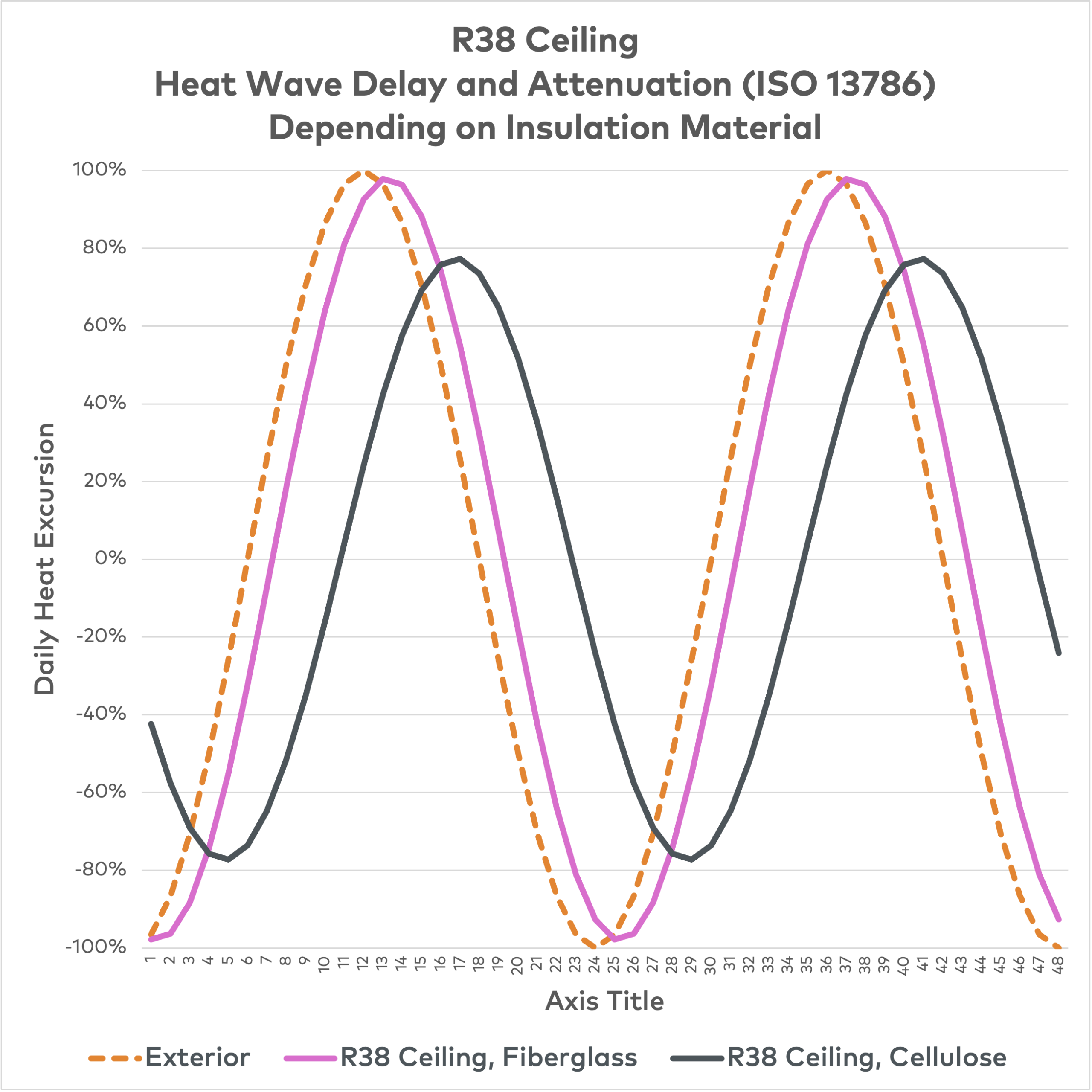
Same nominal R-value. Same compliance checkbox. Wildly different real-world resilience.
- Fiberglass R38 ceiling: delays the heat wave by approximately 1.5 hours, with negligible attenuation of about 2%
- Cellulose R38 ceiling: delays the heat wave by approximately 4.8 hours—roughly three times longer—and attenuates the heat wave by about 22.6%
The cellulose ceiling is the clear winner for heat wave resilience at the assembly level. It buys you hours of delay, pushing peak heat penetration past the hottest part of the day, and it meaningfully weakens the heat that does get through. For projects in warm and hot climates—where budget or space may not allow for thick, high-R assemblies—this is a remarkably effective card to play.
Both ceilings meet the same code requirement. Both carry the same nominal R-value. The cellulose ceiling shifts peak heat penetration well past the hottest part of the day and cuts the transmitted heat by nearly a quarter. In warm and hot climates, where budget or assembly depth may limit high R-values, insulation thermal capacity is an effective way to improve thermal insulation heat wave resilience at little or no added cost.
Continuous Insulation and Summer Heat: How Material Choice Affects Performance
The delay-and-attenuation effect applies to exterior walls too, which makes it directly relevant to continuous insulation layers.
When you specify a continuous insulation layer to address the Summer heat wave, the material choice for the exterior insulation impacts the the assembly performance. A high thermal capacity continuous layer (such as wood fiber or hemp boards) contributes measurable delay and attenuation. A low-capacity foam layer (EPS or mineral wool) contributes almost none, even at the same R-value.
For Summer heat mitigation, the specs for the continuous insulation material extends beyond R-value per inch or cost per board foot. Selecting a higher-capacity continuous insulation product—such as wood fiber or hemp boards—adds measurable dynamic summer performance on top of the assembly’s steady-state thermal resistance.
Heatwave Retrofit Insulation Strategies
Retrofits present a specific constraint: existing framing, rooflines, and interior dimensions limit how much insulation you can add. The available depth is fixed, and the assembly typically cannot be rebuilt.
Insulation thermal capacity offers a path around that constraint. By selecting a high-capacity material for the space available, you improve dynamic Summer performance without rebuilding the assembly. This is the core of effective retrofit insulation strategies to furture-proof buildings agains heat wavers—maximizing delay and attenuation within a fixed insulation thicknesses.
This Summer heat mitigation strategy delivers the greatest return on roofs and ceilings. Roof surfaces receive the most direct solar radiation in summer, and their exterior finishes are frequently dark, which increases absorbed heat. Prioritizing high thermal capacity insulation in roof and ceiling retrofits addresses the assembly under the highest thermal load.
When Thermal Capacity Matters
Insulation thermal capacity is a climate- and season-specific strategy. Applying it correctly requires understanding its boundaries.
- Summer heat waves: thermal capacity is effective because heat flow reverses direction between day and night. The delay-and-attenuation effect depends on this cyclical condition.
- Winter: the benefit is negligible. Heat flows in a constant direction—from the warm interior to the cold exterior—so there is no daily reversal to exploit.
- Warm and hot dry climates: this is where the strategy delivers value, thanks to the daily temperature swings. In humid, cold, and mixed climates, it is far less relevant.
- High R-value assemblies (R60+): the benefit is diluted. So little heat passes through such a thick assembly that additional delay and attenuation matter less.
The strategy fits best at code-minimum to moderate insulation levels in warm and hot climates—precisely the conditions of many projects in these regions.
Conclusion
Insulation thermal capacity adds a measurable layer of Summer heat resilience to any assembly—delaying peak heat transfer and reducing its intensity before it reaches the interior. Plant-based fiber insulation—cellulose, hemp, and wood fiber—delivers the highest capacity while also carrying the lowest embodied carbon. The R38 ceiling example shows the practical difference: a 4.8-hour delay and 22.6% attenuation with cellulose versus 1.5 hours and 2% with fiberglass, at the same code-compliant R-value.
Apply this specification logic to roofs, ceilings, continuous insulation layers, and retrofits in warm and hot climates.
Frequently Asked Questions
What is insulation thermal capacity?
Insulation thermal capacity is a material’s ability to store heat, calculated from its specific heat, density, and thickness. In building assemblies, higher thermal capacity delays and reduces the heat wave passing through the assembly during Summer. It works alongside R-value to describe the full thermal behavior of an assembly under the cyclical temperature conditions of a summer heat wave.
How does insulation thermal capacity improve a building Summer performance?
Insulation thermal capacity describes how an assembly performs under the cyclical temperature conditions of a Summer heat wave—conditions that R-value was not designed to measure. During a heat wave, exterior surface temperatures rise and fall daily, changing both the direction and intensity of heat flow. Thermal capacity determines how long it takes for that peak heat to travel through the assembly (delay) and how much of it is reduced along the way (attenuation). Two assemblies with identical R-values can produce very different delay and attenuation results depending on the density and specific heat of their insulation.
How does thermal insulation protect from heat waves?
Insulation with high thermal capacity produces two effects: delay (time lag), which pushes peak heat penetration later in the day, and attenuation (decrement factor), which reduces the intensity of transmitted heat. These dynamic properties are calculated using ISO 13786 and depend on the insulation material’s density and specific heat.
Which insulation has the highest thermal capacity?
Plant-based fiber insulation—cellulose, hemp, and wood fiber—has the highest thermal capacity due to higher density and specific heat. Foams (EPS, XPS, polyiso) and fiberglass have the lowest. Mineral wool falls in between. Plant-based fibers also carry some of the lowest embodied carbon among insulation products.
How does insulation thermal capacity compare to thermal mass?
Thermal mass uses dense interior materials to absorb heat already inside the building; its summer performance is limited and ranks among the least effective envelope strategies. Thermal capacity works within the envelope assemblies to slow heat before it enters the building. Adding wall mass with brick or concrete is impractical due to high embodied carbon and the wall thickness required..
What are effective insulation strategies to protect retrofitted buildings?
When retrofits cannot add assembly thickness, selecting high thermal capacity insulation maximizes dynamic summer performance within the available space. This improves delay and attenuation without rebuilding the assembly. Roofs and ceilings offer the greatest return for retrofit summer heat mitigation because they receive the most direct solar radiation and often have dark, heat-absorbing surfaces.
Does thermal capacity of continuous insulation help with Summer heat mitigation?
Yes. The delay-and-attenuation effect applies at the wall assembly level, so continuous insulation material choice directly determines its Summer contribution. A high thermal capacity continuous layer—such as wood fiber or hemp board—provides measurable delay and attenuation, slowing peak heat transfer and reducing its intensity before it reaches the interior. A low-density foam layer, regardless of thickness, contributes far less to these dynamic properties.
When does insulation thermal capacity not matter?
The benefit is negligible in Winter, when heat flows in a constant direction with no daily reversal. It is most relevant in warm and hot climates and far less useful in cold or mixed climates. It also becomes less significant where assemblies are already very thick—so little heat passes through that delay and attenuation have minimal practical impact.
Comments are closed.